

Think about this, what if BluePill and RedPill become discontinued just like Maple boards? They are not Open Hardware. I think it would be cool for us to have at least one platform of our own, we release it as Open Hardware, and anyone can get the blueprint to make, to modify, to learn, and even to sell it as it is or its modification. We know that we are not going to be able to beat the price point of BluePill or RedPill at sub $2. But if we can provide users with a BOM they can afford at sub $5, I think this would take off and get its traction. As a starting point, let’s call it as a WhitePill, and this board will be prototyped in white solder mask.
I am volunteering myself to design the board and potentially spend some dollars out of my pocket for prototyping and testing it. If you guys are willing to help with anything, like trying to crowdfund it, you are welcome to help doing it. Should we get a little profit out of it, I think it should go to @RogerClark as he has been the one maintaining this great community and forum. Space are not cheap guys, I believed he has spent some (if not a lot) on his own just to keep this forum alive!
Ok, so let’s start our discussion. I can tell that I am pretty good with Eagle CAD, pretty handy with fine pitch soldering at microscopic level  and able to prototype almost anything. Please respond whether or not you think it is a great idea to have at least one STM32Duino platform as an Open Hardware. Tell us why you think it is (or it is not). And then, if you think about WhitePill, what features should be available to support at least by the core. Let’s focus on having a sub $5 WhitePill first, although we also welcome ideas to have advance features for WhitePill Xtra, WhitePill Combo, etc.
http://www.aliexpress.com/item/STM32F10 … 1312a5df6a
Questions: Is it breadboard friendly? Is 64K too much or reasonable for the basic “Arduino” like system? Should we downgrade to 32K, 16k? I would get rid all of crystals just to save few bucks, potentially also to remove USB connector with something like this:

So, users might need to have this cable or just plug it directly to USB port:
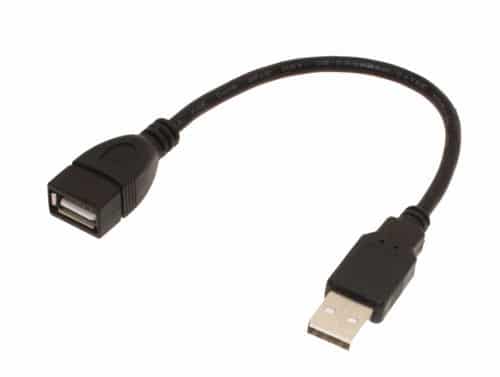
BTW, the crystal too is only removing $0.10 on BoM…
BTW, the crystal too is only removing $0.10 on BoM…
Best, E.
Things like CAN bus and even ethernet are arguably not particularly interesting, for an Arduino style board, but a board with a usable DAC for not much more than the cost of the Blue Pill would be a worthwhile design in my opinion. The ability to power it from batteries might be my second addition to the design.
I am sure he has done multiple posts on this board, but here is just one of them
The GD32 sounds great, but I am afraid we can’t use any ST HAL/Library with it due to ST’s licensing limitation.
The GD32f103CB DIP boards are available for about usd 4 50% quicker than maple mini and officially 128K FLASH.
Can you post me a link to the that GD, in case I feel like buying some. As its a really good price.
 i got a rough calculation from an agent they do the stm equivalent fot $2 approx.
I found an agent that will drop ship so if you wanted some I may get some and get them to send you /others some.
I’ve had a less than godd experience with TaoBao, via yoybuy , they packed some boards into a heavy box, and I got charged more than the price of the boards in additional shipping, (I can’t recall the cost but probably $15 or $20 when the boards only cost less than $15, so it doubled the price)
Cheapest I can find on AliExpress is around $23 USD for 10 off including shipping, which I think is cheaper than STM32F103RC’s but far more than STM32F103C8’s (which I can find for around $1.50 with free shipping up to 4 pcs)
But I already have a load of STM32F103C8’s
I would get rid all of crystals just to save few bucks, potentially also to remove USB connector with something like this:

The problem with Taobao is that you have to use an agent, as the vendors seem only to ship to internally in China.
I bought 2 identical batches of boards, one of which got repacked by the agent, and one didn’t. The one that got repacked doubled the cost and effectively made it uneconomic. (same agent for both)
So you are effectively held to ransom by the agent, as you have already paid for the goods, but they can charge whatever they like to repackage the goods to you.
So Taobao is now my very last resort, as the cost is totally unpredictable.
I’d rather have a small board like the digispark which uses the PCB as the USB connector.
You don’t need a massive crystal, the 8Mhz resonators that @strawberrymaker uses in his designs are small and cheap
Cost would be quite low, as all it would be is
STM32F103C8
8Mhz resonator
2 x 22R USB resistors
1 x 1K5 USB pullup
some SMD decoupling caps
various other SMD pullups / pull downs
Still impossible to build for less than the $2 Blue Pill however, mainly the price of the STM32F103C which they must source very very cheaply
Eagle is quite phasing out with their limited free version.
All Open-Hardware are not shifting to KiCad !
I paid for entry level license for Eagle, but am moving to KiCad where possible
I agree, a new design must be based on F4/L4 parts
I paid for entry level license for Eagle, but am moving to KiCad where possible
I agree, a new design must be based on F4/L4 parts
http://fr.aliexpress.com/item/smd-contr … 97827.html
But there are maybe others, also it is depend of the form factor of the board, the above is a LQFP64, but some others are exclusively LQFP100 and maybe to big for some breadboard friendly boards.
In past, I did like the idea of breadboard mounting, but in practice, a processor board next to breadboard works as well – especially with female connectors. In normal case with male connectors at bottom, the processor board on breadboard acts like board with female connectors.
Cheers, Ollie
Possible candidates are the F401Cx, F411Cx, L475Rx OR L433Cx (which is available in LQFP package)
Possible candidates are the F401Cx, F411Cx, L475Rx OR L433Cx (which is available in LQFP package)
But if there is no consensus on breadboard-friendly, we are not limited in this case.
IMHO, maybe if one could get an M3 with 48K or 64K of SRAM crammed onto something like a MM for a price of perhaps $1 or $2 more with full Arduino support, USB serial, bootloader reset … then maybe I’m listening.
The MM clone is a good-nuff solution to 90% of the problems that I throw at it and it easily fits into my big protoboard or several littl’ ones:
BoxOfMapleMini by Rayburne, on Flickr[/img]
One example of a derivative Stamp is https://www.oshpark.com/profiles/Firebirduino
It cannot be mounted on breadboard, but can be used with breadboard.
IMHO, maybe if one could get an M3 with 48K or 64K of SRAM crammed onto something like a MM for a price of perhaps $1 or $2 more with full Arduino support, USB serial, bootloader reset … then maybe I’m listening.
Then we can continue discussing about MEDIUM and HIGH end versions.
<…>
So a 40 pin maple mini type board for $5 with a lot of extra features should be doable with a SWLINK connector and better usb socket. Baite Minis are US$4 So twice the Twice the FLASH and Twice the speed after taking into consideration the ‘0’ wait state does not seem bad for 25% extra price.
For this LOW level version of OSHW STM32Duino board should include an MicroSD card holder, even if PCB has a length a bit longer than MM, although bottom side has lot of space ?
When I got my Wemos D1 Mini boards, I was impressed by the included long leg female headers. In all honesty, it was the first time I have seen them in “real life”. I was impressed with how sturdy the legs are, and that they can be cut to size.
Back on topic, I see the following potential advantages in using these headers, with regards to breadboard friendliness:
- the STM32duino dev board can be made a bit wider than a traditional DIP 40 size, since with these headers, the wires can be inserted into the header, and then routed to the required spot on the breadboard, as long as the headers can still fit on the breadboard
- although the legs of the headers are long, if the dev board is fully inserted into the breadboard, there is a gap of only about 5mm between the top of the breadboard and the bottom of the dev board, thus leaving some space to possibly mount components on the bottom of the dev board, as was done with the D1 mini
@Just4Fun: Do you think you can help doing the layout on KiCad? Any kind of help would be great, like generating 3D parts for us to see!
- it seems strange to me that a site called “Arduino for STM32” (aka stm32duino.com) proposes a reference board based on a GD32 chip..
- are GD chips well documented and well supported here?
And here my HW whishlist:
- proc >= F103CBT6
- an embedded USB2Serial adapter (i.e. CH340G) bound to USART1
- an eeprom (even thought an SD could be better)
- AMS1117 as LDO
- Maple reset HW
- Support for concurrent power from USB, VIN and VBAT together with necessary protection circuits
- User button & led
- HSE and LSE crystals
One more question: did you already consider assembling, packaging and shipping expenses?
Best, E.
[*]an embedded USB2Serial adapter (i.e. CH340G) bound to USART1
- it seems strange to me that a site called “Arduino for STM32” (aka stm32duino.com) proposes a reference board based on a GD32 chip..
- are GD chips well documented and well supported here?
AMS1117 is the worst LDO, it has a quiescent current of 5 to 10mA even without load.
There are some like SPX3819 with quiescent current of 100uA to 1mA, or even better HT7333 or the best XC6203.
<…>
Remember this is a dev board if you want to make a low power device you can use an external regulator, a good power out is important.
<…>
I also think 250mA is too low.
I use the regulated 3.3V output from the Mini Maple to power an ILI9341 as well as a 433Mhz TX/RX (nRF51822) and some other external devices, e.g. SD card.
BTW.
I recall this phase being used for another board that was being discussed..
Eierlegende Wollmilchsau
https://en.wiktionary.org/wiki/eierlegende_Wollmilchsau
250mA is a bit “weak” IMO for a dev board.
When I suggested some more efficient LDO, that was only to show that AMS1117 was a bad LDO if some people which to do some battery operated.
Of course in other application which doesn’t need to be power efficient, external hardware can still take it’s power from 5V and use AMS1117 externally to drive its sucking peripherals !
But the main goal of any STM32Duino OSHW is to be efficient as a standalone board !
The guys selling those cheapo “everything” boards think BIG – they order a batch worth $10000 cost and do $5000 profit upon selling it to distributors (the guys perform a day to day business, not a hobby).. Also mind they utilize their vast production landscape where the big guys order in 100k-1mil quantities, so the parts cost almost nil.
Any of these for example: https://github.com/gbulmer/openstm32hw
These are already available for the community, as they are Open Hardware.
When they are populated with STM32F103, they run libmaple, and the bootloader.
If they are populated with STM32F3, there are more interesting and useful peripherals like stereo DAC.
IIRC some have been populated with STM32F4, but you’d need to comb through an archive of Leaflabs forum for details.
Some of them are designed for single-sided PCBs, and DIY. I like low-cost, but I also like DIYable.
I use boards in school classroom’s.
I am *not* a fan of ‘the USB plug is the PCB’ in that context. The PCs are sometimes under the table, or the only free socket is at the back of the machine. So the PCB-is-the-USB-plug are a bit of a PITA.
I have learned to like USB micro because lots of folks already have a power supply and cable, because they already have a phone. That is important to me because we encourage people to make things (and not just program), and the power supply is often an obstacle that needs to be overcome.
Many of the ‘mini-projects’ our students make would be okay with 250mA. However, when the students want to assemble something more complex, usually from several mini-projects, 500mA starts to become a constraint.
So either make it easy to add a more powerful (add-on?) power supply, without making it hard to program the board, or 250mA is too little power.
Any of these for example: https://github.com/gbulmer/openstm32hw
These are already available for the community, as they are Open Hardware.
These are already available for the community, as they are Open Hardware.
I have some STM32 designs that I would be prepared to “open up” for the benefit of this group.
1. A 40 pin DIL format using a 48 pin LQFP called ARMiGo
http://sustburbia.blogspot.co.uk/2014/0 … 3-arm.html
2. A Pi HAT format board that accepts a 64 pin LQFP – Called “Piano Forte”. Has 3 choices of wireless module on board
http://sustburbia.blogspot.co.uk/2015/0 … forte.html
3. A 62mm x 62mm breakout board that accepts a 100 pin LQFP – breaks out to the same pin pattern as an F4 Discovery
http://sustburbia.blogspot.co.uk/2015/0 … sting.html
4. A 64 pin LQFP and FPGA combo called myStorm which breaks out to Arduino format pin headers. Has a GPIO header to accept Pi or Pi Zero
https://folknologylabs.wordpress.com/20 … ect-storm/
Ken
But please, use a proper USB socket and not these on PCB things. they will wear out so fast, and you would have to use something like a ENIG Plating, which costs $$$.
Pricing: Yeah, you can definatly get away with 4-5$ in BOM. Assembly could also be done at home,with a smd sucker, a stencil and a modded oven. But you still will spend time with it. if you would make a business out of it, you would have to sell it then for 10-15$.
~Straw
1. A 40 pin DIL format using a 48 pin LQFP called ARMiGo
In regards to arduino 32 COMMUNITY HARDWARE…
I would be interested in contributing to the betterment of the 32duino community and offer my aid in making the 32duino Hardware a reality.
This is in no way a sales call, my only interest is to help the community as I happen to be in a unique situation that could help all.
My only ulterior motive is that I am working to learn more about using Arduino with 32 MCU’s. Specifically GIGADEVICE MCU’s
I own an electronics contract manufacturing facility in New England USA. Ironically I also own one of the few distributors in the US who distributes GIGADEVICE.
My CM business has 4 high speed surface mount lines and we are adding two more. I know how to build products at the best price and would be more than willing to cover much of the cost to get this project off the ground
I have access to materials worldwide in addition to the GIGADEVICE parts so we can design in the best value materials.
If there is interest from the community please let me know. I can also present this as an opportunity to GIGADEVICE and I expect they would provide special pricing and/or free samples to get this project moving and help out the community.
I have intentionally not put by business information on this post so that it does not look like a sales call…
I hope everyone well and look forward to working together!
thanks!
greg
Sorry I didnt reply to your email. (I will reply now)
Re: Open hardware
Several people are developing boards, try PM’ing @strawberryMaker as has been making one, and also PM @grumpyoldpizza as he has developed sw for another board (but I can’t remember who makes it)
GD devices are interesting but have not got much traction
I actually have about 15 GD32F103C8 boards I bought from TaoBao, (I only wanted 10 but there was a mix up with the order)
I know several other people who either have GD32 or are interested in GD32 because of price vs performance.
At the moment our support of GD32 is not that good, because I’ve not had time to figure out why the SPI doesn’t work
(SPI does send data but none of the peripherals I have tried, think the data is valid. I suspect its something to do with the SPI mode or clock vs data timing mode etc, as I think the GD32 has additional SPI modes and perhaps does not default to the same mode the STM32 does – or at least not using our core software)
BTW. I run the GD32F103C8 at 120Mhz (and have USB) and they all seem OK, even though this is 10% above their spec
The wierd thing with the USB divider is that the max permitted speed with a valid USB divider is 96Mhz but the GD32 is spec’ed to 108Mhz. Luckily there is a USB divider that works at 120Mhz. So my only conclusion was that it was GD’s original intention to spec them at 120Mhz but found in production that his speed could not be guaranteed over an industrial temperature range.
Since Greg might be able to get GigaDevice, I think we should have at least one board made with it.
sadly, i wouldnt say that my 3dprinter/cnc controller is really ready for a bigger production  .
.
I could maybe try to revice the STaps, but i dont have that much time in the next few months, so i guess it would be better to take someone else’s designs like the ones from @monsonite
~Straw
The next question would be, how many serial, SPI, I2C, CAN ports we’d like to have on the board? then I can help to choose the part number from here. Thank you.
(I have not tried running and STM HAL code on the GD32, it may work, but STM may hVe delibarately put things into their HAL that break to operation of the GD32)
But Libmaple can be used.
Also GD have their own Standard peripheral library / CMSIS etc, but not an equivalent of the HAL.
Bt hardly anyone has and GD32 boards, so its hard to know what incompatibilities there are
Thanks
He runs a production facility in the USA
He was interested in the GD32 as they are faster and cheaper than the STM32, but there are some slight compatibility issues.
But they are interchangeable so he could probably make you either a GD32 or and STM32 board
Thanks to all for all any ideas/insight
Thanks to all for all any ideas/insight
Thanks again.
I would start with the Maple Mini files that leaflabs made open source on github.
Then either buy Cadsoft Eagle, basic commercial version , which was around $100 when I bought it.
Or convert to KiCad.
Then output all the files to machine manufacture the board, and get a company to machine build a small batch.
actually, you’ll probably need to get them to hand build a few first e.g. 2 or 3 to check the pcb and bom is correct.
Then get them to machine make a few, perhaps 50.
when you have all the files and process nailed down, you should be able to send those files to different companies in the future.
Or just buy 5 years supply of Maple Minis from Baite.
https://www.aliexpress.com/item/10pcs-l … 70994.html
Ray

