
a greeting
UID site:stm32duino.com
The above results in: viewtopic.php?t=245
Ray
I had searched by putting the name of the record and nothing appeared with direct relationship.
Thank you
1. Read the datasheet – this is always going to be your first step.
2. Find out where the uid is located, as their location is family specific.
3. Fix a data type of your choice to that address.
4. Done.
I’ve done some of the work for the Nucleo boards – Feel free to update the example below based upon Roger’s input from:
viewtopic.php?t=245
Best regards,
Frank
// STM32L476

// http://www.st.com/content/ccc/resource/technical/document/reference_manual/02/35/09/0c/4f/f7/40/03/DM00083560.pdf/files/DM00083560.pdf/jcr:content/translations/en.DM00083560.pdf

// STM32L432

// http://www.st.com/content/ccc/resource/technical/document/reference_manual/group0/b0/ac/3e/8f/6d/21/47/af/DM00151940/files/DM00151940.pdf/jcr:content/translations/en.DM00151940.pdf

// STM32F446

// http://www.st.com/content/ccc/resource/technical/document/reference_manual/4d/ed/bc/89/b5/70/40/dc/DM00135183.pdf/files/DM00135183.pdf/jcr:content/translations/en.DM00135183.pdf

// STM32F303

// http://www.st.com/content/ccc/resource/technical/document/reference_manual/4a/19/6e/18/9d/92/43/32/DM00043574.pdf/files/DM00043574.pdf/jcr:content/translations/en.DM00043574.pdf
uint16_t flashsize;
uint32_t UnitID_Part_1;
uint32_t UnitID_Part_2;
uint32_t UnitID_Part_3;
void setup() {
Serial.begin(115200);
#if defined(ARDUINO_NUCLEO_F303K8)
// UID for F3 devices in general as I google the info
flashSize = *(uint16_t *)(0x1FFFF7CC);
UnitID_Part_1 = *(uint32_t*)(0x1FFFF7AC);
UnitID_Part_2 = *(uint32_t*)(0x1FFFF7AC+0x04);
UnitID_Part_3 = *(uint32_t*)(0x1FFFF7AC+0x08);
#elif defined(ARDUINO_NUCLEO_F446RE)
// UID for F4 devices in general as I google the info
flashSize = *(uint16_t *)(0x1FFF7A22);
UnitID_Part_1 = *(uint32_t*)(0x1FFF7A10);
UnitID_Part_2 = *(uint32_t*)(0x1FFF7A10+0x04);
UnitID_Part_3 = *(uint32_t*)(0x1FFF7A10+0x08);
#elif defined(ARDUINO_NUCLEO_L432KC) || defined(ARDUINO_NUCLEO_L476RG)
// UID for L4 devices in general as I google the info
flashsize = *(uint16_t *)(0x1FFF75E0);
UnitID_Part_1 = *(uint32_t*)(0x1FFF7590);
UnitID_Part_2 = *(uint32_t*)(0x1FFF7590+0x04);
UnitID_Part_3 = *(uint32_t*)(0x1FFF7590+0x08);
#else
#error "No board recognized"
#endif;
}
void loop() {
Serial.print("Flash size is ");
Serial.print(flashsize );
Serial.println(" kB");
Serial.print("UID [HEX] : ");
Serial.print(UnitID_Part_1, HEX);
Serial.print(" ");
Serial.print(UnitID_Part_2, HEX);
Serial.print(" ");
Serial.println(UnitID_Part_3, HEX);
delay(1000);
}
ex for STM32F103:
https://github.com/stm32duino/Arduino_C … 3xb.h#L674
#define FLASHSIZE_BASE        0x1FFFF7E0U    /*!< FLASH Size register base address */

#define UID_BASE 0x1FFFF7E8U /*!< Unique device ID register base address */
/Frank
[HutTheNut – Fri Mar 30, 2018 5:44 pm] –
As I read the link, the addresses are not generic and for the STM32F1xx only…/Frank
Those defines are generic not its value and for all STM32YYxx families.
But coming from my lack of knowledge.. In order to avoid usage of switch for each board.
How do I access these #defines through compilation assuming I don’t know where to look in the register as the following example does in my search for a generic piece of code..?
#if defined(ARDUINO_NUCLEO_F103CB) || defined(ARDUINO_NUCLEO_F103C8) // Add more F1-board if necessary
// UID for F1 devices in general as I google the info
#define FLASHSIZE_BASE 0x1FFFF7E0U // FLASH Size register base address
#define UID_BASE 0x1FFFF7E8U // Unique device ID register base address
#endif;
There is the final code-contribution for now.. I hope it will come in handy for some – And feel free to improve it! 
// STM32L476

// http://www.st.com/content/ccc/resource/technical/document/reference_manual/02/35/09/0c/4f/f7/40/03/DM00083560.pdf/files/DM00083560.pdf/jcr:content/translations/en.DM00083560.pdf

// STM32L432

// http://www.st.com/content/ccc/resource/technical/document/reference_manual/group0/b0/ac/3e/8f/6d/21/47/af/DM00151940/files/DM00151940.pdf/jcr:content/translations/en.DM00151940.pdf

// STM32F446

// http://www.st.com/content/ccc/resource/technical/document/reference_manual/4d/ed/bc/89/b5/70/40/dc/DM00135183.pdf/files/DM00135183.pdf/jcr:content/translations/en.DM00135183.pdf

// STM32F303

// http://www.st.com/content/ccc/resource/technical/document/reference_manual/4a/19/6e/18/9d/92/43/32/DM00043574.pdf/files/DM00043574.pdf/jcr:content/translations/en.DM00043574.pdf

// STM32F1

// https://github.com/stm32duino/Arduino_Core_STM32/blob/af3d2e7fcd1ae9b5eaa56b22aca6e148e40fda69/system/Drivers/CMSIS/Device/ST/STM32F1xx/Include/stm32f103xb.h#L674
uint16_t flashsize;
uint32_t UnitID_Part_1;
uint32_t UnitID_Part_2;
uint32_t UnitID_Part_3;
String UnitName;
// System clock speed
extern uint32_t SystemCoreClock;
void setup() {
Serial.begin(115200);
Serial.println("");
Serial.println("Serial communication is running OK");
Serial.println("");
Serial.println("Compiled : " __DATE__ ", " __TIME__);
Serial.println("Version : " __VERSION__);
Serial.println("");
//Reading type of board
#if defined(ARDUINO_NUCLEO_F103C8)
UnitName = "NUCLEO_F103C8";
#elif defined(ARDUINO_NUCLEO_F103CB)
UnitName = "NUCLEO_F103CB";
#elif defined(ARDUINO_NUCLEO_F103CB)
UnitName = "NUCLEO_F103RB";
#elif defined(ARDUINO_NUCLEO_F303K8)
UnitName = "NUCLEO_F303K8";
#elif defined(ARDUINO_NUCLEO_L432KC)
UnitName = "NUCLEO_L432KC";
#elif defined(ARDUINO_NUCLEO_L476RG)
UnitName = "NUCLEO_L476RG";
#elif defined(ARDUINO_NUCLEO_F446RE)
UnitName = "NUCLEO_F446RE";
#else
#error "No board recognized"
UnitName = "No board recognized";
#endif
// Reading Flashsize and Unit ID
#if defined(ARDUINO_NUCLEO_F103CB) || defined(ARDUINO_NUCLEO_F103CB)
// UID for F1 devices in general as I google the info
#define FLASHSIZE_BASE 0x1FFFF7E0U // FLASH Size register base address
#define UID_BASE 0x1FFFF7E8U // Unique device ID register base address
#elif defined(ARDUINO_NUCLEO_F303K8) // Add more F3-board if necessary
// UID for F3 devices in general as I google the info
#define FLASHSIZE_BASE 0x1FFFF7CC // FLASH Size register base address
#define UID_BASE 0x1FFFF7AC // Unique device ID register base address
#elif defined(ARDUINO_NUCLEO_F446RE) // Add more F4-board if necessary
// UID for F4 devices in general as I google the info
#define FLASHSIZE_BASE 0x1FFF7A22 // FLASH Size register base address
#define UID_BASE 0x1FFF7A10 // Unique device ID register base address
#elif defined(ARDUINO_NUCLEO_L432KC) || defined(ARDUINO_NUCLEO_L476RG) // Add more L4-board if necessary
// UID for L4 devices in general as I google the info
#define FLASHSIZE_BASE 0x1FFF75E0 // FLASH Size register base address
#define UID_BASE 0x1FFF7590 // Unique device ID register base address
#endif;
flashsize = *(uint16_t *)(FLASHSIZE_BASE);
UnitID_Part_1 = *(uint32_t*)(UID_BASE);
UnitID_Part_2 = *(uint32_t*)(UID_BASE+0x04);
UnitID_Part_3 = *(uint32_t*)(UID_BASE+0x08);
// Board type, UnitID and flashsize
Serial.println("Board : "+UnitName);
Serial.println("CPU speed : "+String(SystemCoreClock/1000000)+" MHz");
Serial.println("Flash size : "+String(flashsize)+" kB");
Serial.println("UID [HEX] : "+String(UnitID_Part_1, HEX)+" "+String(UnitID_Part_2, HEX)+" "+String(UnitID_Part_3, HEX));
Serial.println("");
delay(2000);
Serial.println("Press A for Board type");
Serial.println("Press B for CPU speed");
Serial.println("Press C for flash size");
Serial.println("Press D for UID");
Serial.println("");
}
void loop() {
if(Serial.available()) {
char inChar = (char)Serial.read();
switch (inChar){
case 'A': Serial.println("Press A for Board type"); break;
case 'B': Serial.println("CPU speed : "+String(SystemCoreClock/1000000)+" MHz"); break;
case 'C': Serial.println("Flash size : "+String(flashsize)+" kB"); break;
case 'D': Serial.println("UID [HEX] : "+String(UnitID_Part_1, HEX)+" "+String(UnitID_Part_2, HEX)+" "+String(UnitID_Part_3, HEX)); break;
}//End_Switch
}//End_If
}//End loop
To be more generic with board name, I’ve added a define to recipe.cpp.o.pattern in platform.txt after -DARDUINO_{build.board}
I thought that I had to make the #defines myself at the top of the script with the ecaxt same names : UID_BASE and FLASHSIZE_BASE.. And trying that, I’ve got errors. And that’s why I kept the “board-case”. But still, thanks for being patience with me.
However the board is not recognized – do you have any idea way that is..?
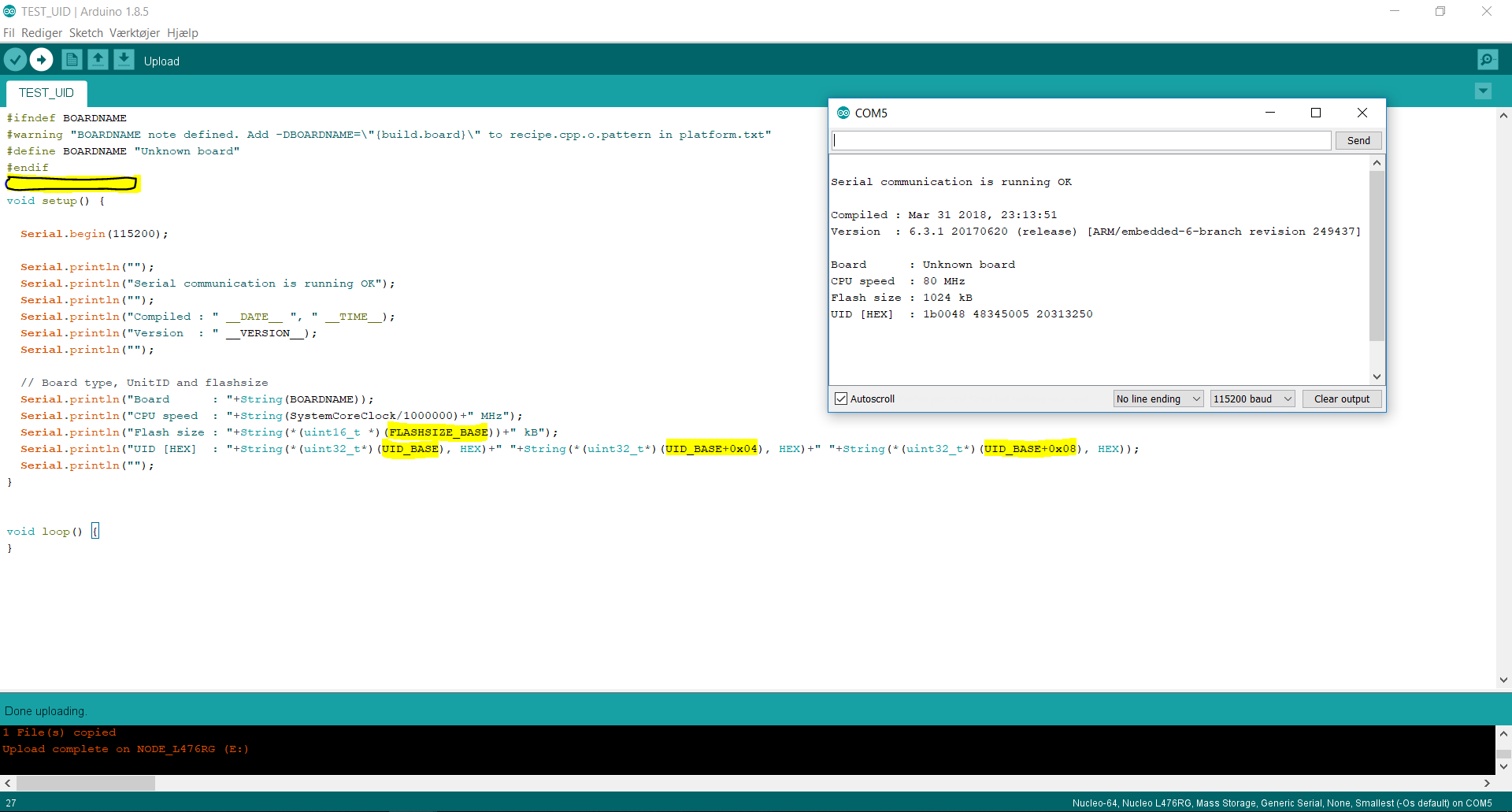
- Almost perfect
- UID_almost_perfect.PNG (84.66 KiB) Viewed 1164 times
https://github.com/stm32duino/Arduino_C … m.txt#L101
/Frank
Is there way of reading the usages of Flash and SRAM from sketch..?
Sketch uses 59564 bytes (5%) of program storage space. Maximum is 1048576 bytes.
Global variables use 2748 bytes (2%) of dynamic memory, leaving 95556 bytes for local variables. Maximum is 98304 bytes.
C: – paht removed by author
1 File(s) copied
Upload complete on DIS_L4IOT (E:)
Thanks in advance
Frank
viewtopic.php?f=29&t=3470
I’ve been searching through the site for a couple of days now, but I don’t seem to have luck.. Can you recall the link for this question..?
The “BOARDNAME” in this thread aka -DBOARDNAME=”{build.board}” in the platform.txt file has been changes to -DBOARD_NAME=”{build.board}”.
So in order for the code to work, just change the name : BOARDNAME to BOARD_NAME
Br.
HTN
https://github.com/stm32duino/Arduino_C … 9575fbe31d


![[Pending Enhancement] RTC values resetting](https://sparklogic.ru/wp-content/uploads/2019/11/nucleo-l476rg-zestaw-startowy-z-mikrokontrolerem-z-rodziny-stm32-stm32l476-90x90.jpg)