
OSH Park say it can be programmed via the Arduino IDE, but I’m not sure which core they are using, or whether they have written their own.
https://www.oshpark.com/shared_projects/UsVw5yxK
I’m not sure if @onehorse on the teensy forum is OSHPark or someone else, as he mentions not good support via libmaple (indirectly), i.e as its an L4 not and F4 and points out our F4 support is not strong (which is true)
I thought perhaps they were going to use Koduino, but it still only has support for F405, and mostly supports F3, as thats the board Avik designed.
Anyway. Interesting development, especially if someone is writing a whole new core from scratch with full Arduino compatibility
STM32F4STamp
I just started looking at it yesterday. He has given out the Schematic and Board files. Too many to-dos for me right now. 
Oh, there is a version .02 of that Dragonfly
Dragonfly
Michael
STM32F4STamp
I just started looking at it yesterday. He has given out the Schematic and Board files. Too many to-dos for me right now.
Hi Michael,
I’m using this board that Frank gracefully sent me two years ago.
It is a bit because of that board that I’m on this forum since the beginning (and a bit before when it was part of Arduino forum)
I’m also using a Netduino2Plus, which is also an STM32F405.
I really like this chip, so I’ve used it in my own design.
But my track record of soldering F103s is not good and I suspect I would initially damage a lot of F4s if i built one of these boards.
But my track record of soldering F103s is not good and I suspect I would initially damage a lot of F4s if i built one of these boards.
<…>
I’ve got to wait a while before I can spend any more money on projects. I need to build what I have for now I guess.

Yeek! Sounds like the spousal auditor made a visit to your man cave (Ham Shack in your case!)
Ray
Are you going to “spin” your own boards for production? What is your planned development strategy for IDE?
<…>
Those chips were not ordered for personal project, but for my daily job,
I have desperately wanted to use the STM32F4 and now L4 for at least two years but have been stymied by the difficulty of learning how to use the simplest non-Arduino toolchains including attempts with Keil, Crossworks, Eclipse and mbed. I got furthest with mbed and was able to translate a few of my Teensiduino sketches and make use of the STM32F401 Nucleo board to read sensors and do simple sensor fusion.
I started designing a Teensy-like STM32L4 with the intent of using it in the same way but was happily surprised to receive an unsolicited offer to help from Thomas Roell, who has been working to write from existing code and scratch an Arduino overlay that will allow the STM32L4 (and F4 later) to be programmed over the USB cable with an Arduino IDE just like the teensy. The hardware design took quite a bit longer than I expected as is the software, but the hardware is essentially done. I am waiting on the final proof pcbs from OSH Park and then I will order a small build from China for additional testing and the start of regular sales at Tindie, where a few prototypes are listed mostly for advertisement.
The Arduino IDE is intended to support most if not all of the usual serial (SPI, I2C, UART, etc) libraries as well as a drag and drop file system for the use of the on-board 16 Mbyte QSPI flash.
I expect to use the Dragonfly for portable (wearable) applications and remote data logging. I have designed the board with large solder pads on the back so I can solder small add-on boards holding sensors or radios, etc. I only have one so far with the MPU9250 and BME280 which together with the 16 MByte QSPI flash and the low-power, battery operated nature of the Dragonfly will make a great remote environmental data logger.
I have programmed the Dragonflys I have assembled with dfu-util using precompiled binaries provided by Thomas. I am anxiously awaiting delivery of the first basic Arduino capability, which i expect at the end of April or so. Progress is slow since there is essentially only one person doing all of the detailed work to make sure USB works, etc. My hope is that after the basic capability is developed and made available, users will step up and make the device as useful as it can be. The latest design of the board is here: https://www.oshpark.com/shared_projects/xTPoZ2ID
and we plan to make the software open source as well.
I would be interested in any comments and/or suggestions for improvement. It’s a very exciting project for me and I am looking forward to using the Dragonfly for all of my work.
I can’t see a USB port on your design. Does it have one?
I’m not being deliberately negative, I’m just trying to be realistic, and.. I’m sure a small STM32F4 board would be useful to some people.
However I suspect that cost for you to produce this board may be an issue.
If your board is not less expensive than a Teensy, I suspect people will buy a Teensy instead, as Paul puts in a huge amount of time and effort into support and library writing etc to make the Teensy a very mature and stable product.
I know the F4 outperforms the MCU on the Teensy, but people looking for faster MCU’s than the Teensy can now get the RPi Zero for $5 (when its actually available).
Some marginally valid opinions:
The RPi zero is great. But many Teensy users employ that Teensy 3x board for things that any RPi would be hard pressed to do, like driving video walls made of programmable strings of LEDs. I do feel that the majority of things done with the Teensy, and even AVRs, can be done on RPi. But not all.
And some people want the Teensy/Arduino libraries for external devices like the LED strings, LCDs of all kinds, the high rate sensors used as drift-less gyroscopes (MEMs), and so on. Plug and play, so long as you don’t use incompatible libraries concurrently… this is the bane of Arduino/Teensyduino and user contributed libraries. But, it’s a hobby.
Price: Teensys are so low cost I would not expect a few $ cheaper to swing the buyer away. If so, perhaps Maple would have gone bigger. Or the Atmel SAM based Arduino-alikes.
I can’t see a USB port on your design. Does it have one?
https://www.tindie.com/products/onehors … out-board/
I welcome all comments; you won’t hurt my feelings.
This board is expected to do whatever a Teensy can do plus a lot more. It is more expensive at $29.95 simply because it comes with the supercap battery backup, rgb led, 16 Mbyte of QSPI flash, and 32.768 kHz crystal the Teensy lacks. The build cost is just under $20 which I expect to come down after the initial 100 unit batch since the volumes will increase and NRE costs diminish.
The idea is to use the USB connector (yes, there is one) to program the device using the Arduino IDE, just like the Teensy. At first, it won’t have all of the libraries people have created for the Teensy and it won’t have the user base or active Forum (duh!), and it won’t have Paul Stoffregen spending every waking moment answering peoples’ forum questions. So this might be a downside.
I see the experienced Teensy user as a prime user candidate for this board. It will do more than the Teensy, faster than the Teensy, with more peripherals than the Teensy but is as easy to program as the Teensy. That is the value proposition.
I bought a Raspberry Pi zero from Adafruit, but frankly, I don’t know what to do with it. At least with Dragonfly, people who have used an Arduino or Teensy will know to plug in the USB cable, see the blinking light, and go from there.
Can it be better? I think so, and we have plans for a cheaper STM32L432 version and a higher performance STM32F4 version in the same Teensy-sized form factor.
All suggestions for improvement or slams at our stupidity are welcome!
This is a slightly older version which doesn’t include the 22 Ohm resistors or the TVS diode on the D+/D- lines. There might be one or two other minor mods, but if you want to look at the schematic for some reason, it is there.
I didn’t scroll further than the pinout … Now I did …

Though, it would be nicer if it was a pdf, so that I would need to ware my glasses …
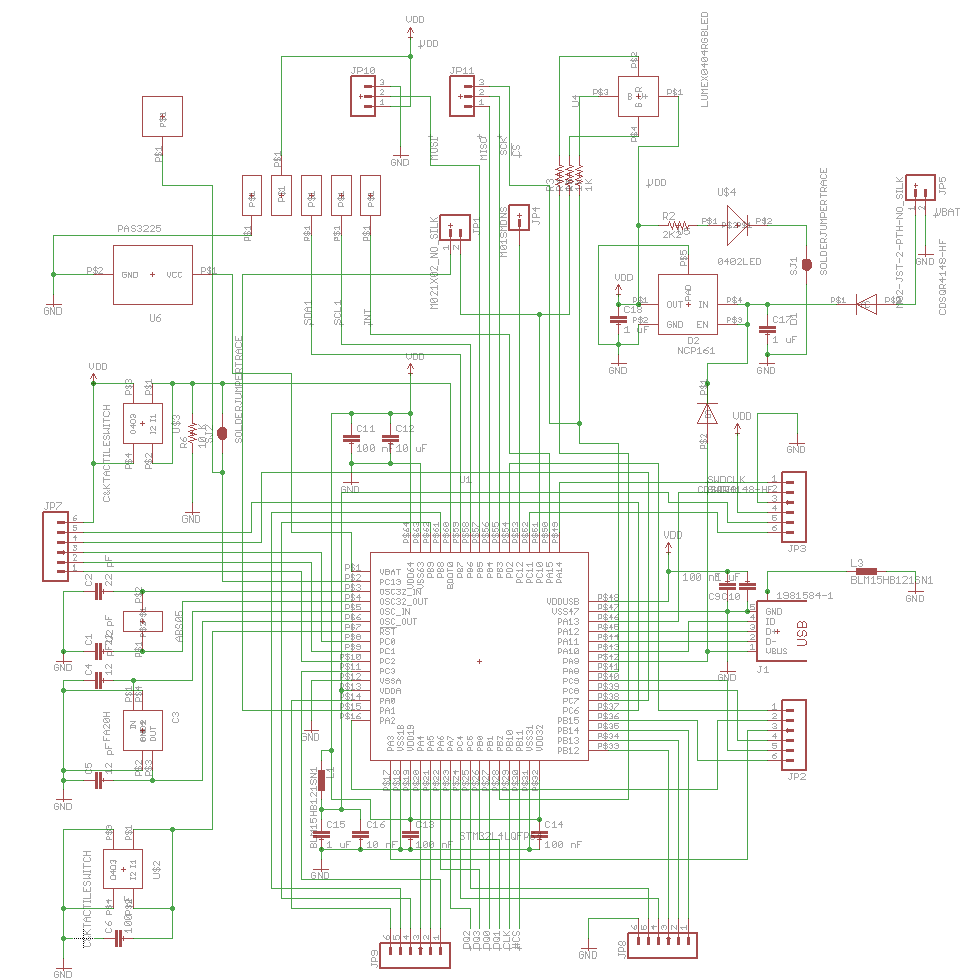
My design is based on Frank Zhao’s F4Stamp that quite a few members have it.
I uploaded Gerber files to Oshpark. You can see it from the following link.
http://www.firebirduino.com/


