
https://www.aliexpress.com/store/produc … 02699.html
I don’t think the pinout is quite the same as the BluePill, it looks like it may be the same pin spaceing etc
I’ve noticed those a while ago, but feel they are a bit pricy …
Prices of ESP32 went down a lot in past few months, for around the same price of those Widora, you can get an ESP32 with OLED along with LoRa such as those :
https://www.aliexpress.com/wholesale?ca … esp32+oled
I’ve received a set of two recently, but didn’t get chance to try them out, still “time is the missing ingredient” …
I totally agree, they are now completely overpriced.
Re: EPS32 Lora
I got 2 of them for Christmas, but for me time, is also the missing ingredient.
Repairs to our house are taking up a significant proportion of my time at the moment
[RogerClark – Sat Jan 06, 2018 12:07 am] –
Repairs to our house are taking up a significant proportion of my time at the moment
Coincidently, I’ve sold my previous house in November, and I’m currently spending most of my time building a new one … 
Just as a matter of interest, what are the problems with this board and do you know how pin compatible it is with the Blue Pill?
https://www.adafruit.com/product/3269
They work as advertised. Back when I purchased, they were on a special for $10.
I have 2 of the LoRa ESP32 boards with OLED. I have used the ArduinoIDE to program several sketches just checking the ESP32, but I have not energized and tested to radio. The WiFi and ESP32 and PC USB all work well.
https://www.aliexpress.com/item/2pcs-86 … 47451.html
Ray
This ESP32 has totally different pins than any F103 board. My problems have been with WiFi connections. I have over 10 different ESP32 boards and most of them are totally OK. I am pleased with the Adafruit board apparent quality, but I don’t like its size.
For ESP32 WiFi, there seem to be new 3 dimensional antennas which could be better than the copper lines on PCB. I don’t yet have any experience with those.
[Slammer – Sun Jan 07, 2018 12:33 pm] –
There is also another board with slim factor, the ESPio32. It is not very common but you can find it on ebay for about 12$,
not visible on aliexpress with simple search
srp
I thought perhaps they had designed the board as a drop in replacement for the Blue Pill, but if thats not the case then its just yet another ESP32 board… Nothing of interest, especially considering its far more expensive than other ESP32 boards
[zmemw16 – Sun Jan 07, 2018 6:47 pm] –
not visible on aliexpress with simple search
srp
I bought it from bsfrance.fr because of fast delivery in EU, (paying something more…) but now is not listed in their site. It seems that this board did not gain popularity and only some sellers in Ebay are still selling it (search ESPio32 in ebay). Actually I like this board for breadboard use, besides the problem with the autoreset (OTA working perfectly)
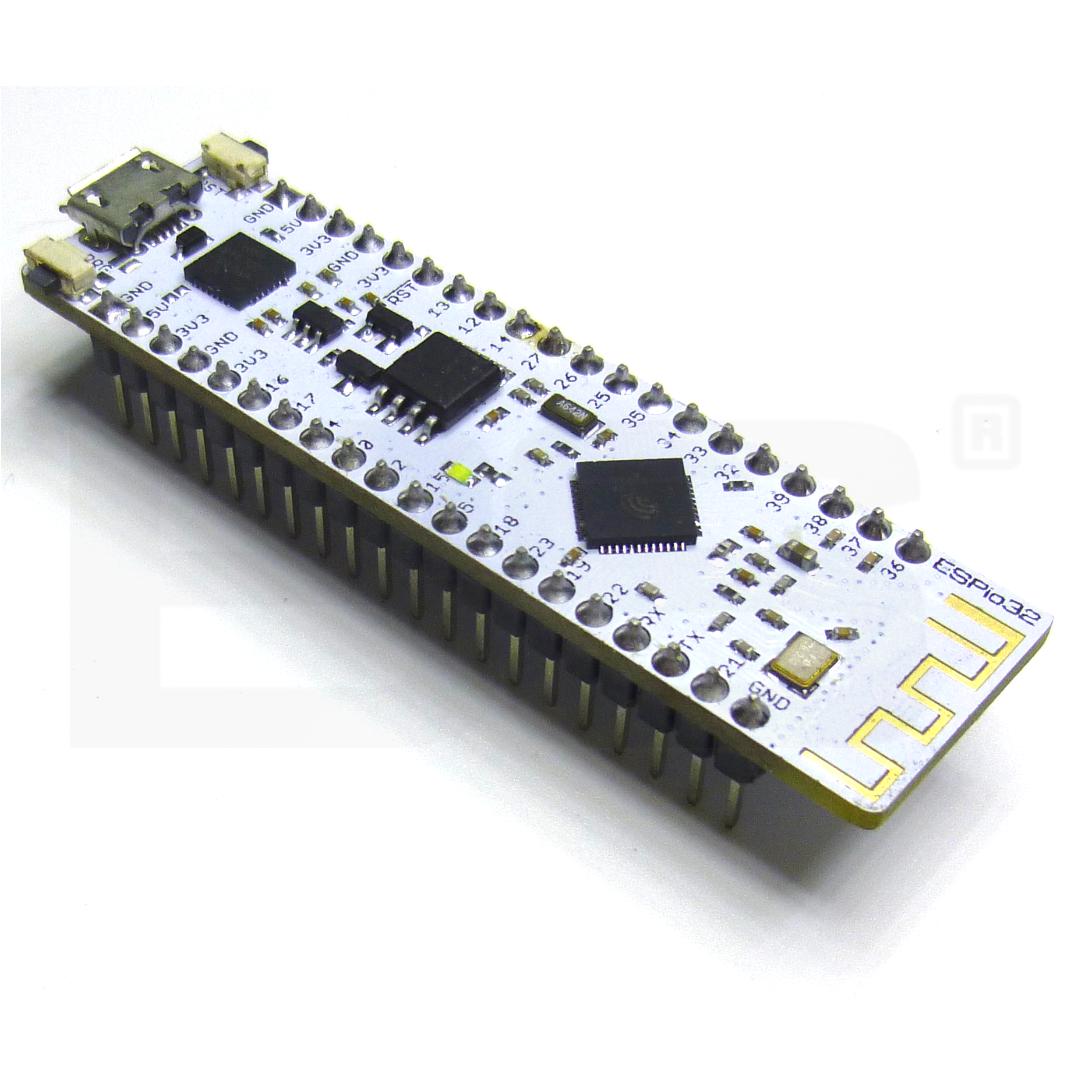
- s-l1600.jpeg (92.44 KiB) Viewed 843 times

My first impressions are very positive. Compared to the Widora Air, the wireless connection seems to be more stable. Perhaps the new 3D antenna is a major factor. On many of my ESP32 board, the PCB antenna gets quite warm/hot when transmitting. On Pico D4, the metal antenna stays lukewarm. This board is 0.1″ wider and 0.5″ shorter than the Widora Air.
In Pins_Arduino.h file, Widora has 7 digital and 10 AI pins. Pico has 40 digital and 16 AI pins. This is more a reflection of the Arduino support than the actual hardware.
As discussed before, the pinout is totally different from BP and all other ESP32 boards. The layout implies that a major intended application is an IOT device with 10 key touch panel with some sensor interfaces. There is no user LED on this board. If an external power supply provides the nominal 3.3V then even the power LED will not be active. The most power consumption is for wireless communication and this can be minimized.
The Arduino IDE support (pins_arduino.h) is not complete. The pins 9, 10, 37, and 38 are missing from the list. Pins 36 and 39 are mentioned in the list, but not wired from the chip.
The pin layout is quite nice. Starting on the top row we have
- 21, 22 for I2C
- 19, 23, 18, 5 for SPI
- 9, 10 for something else, perhaps SPI CS
- 3, 1 for UART
- 35, 34 for GPIO, but not for touch
- 38, 37 for SENSOR_CAPP – I don’t know what this is
- EN for Reset
On the bottom row, we have
- 25,26 for DAC
- 32 .. 0 for GPIO and touch
Note: The pin 0 is used for BOOT and required when loading a new program from Arduino IDE. In this case, the Reset and Boot control by the CP2102N signals DTR and RTS works properly and there is no need to use the two buttons on the board in any use cases.
The pins used for flash programming are available on this board but should be used only without compromising the flash functionality.

