
WARNING: DANGEROUS EXPLOSIONS HAVE BEEN REPORTED BY MANY WHEN CHARGING MORE COMMON LiON BATTERIES.
I have a couple of solar floodlights in the yard, one in the front to illuminate the Security Firm sign and one in my wife’s garden to illuminate her prized porcelain cat (do not ask.) These have worked flawlessly for a couple of years, but the garden unit failed to recover after the long, harsh winter. My options were to replace the unit in total ($19 USD) or purchase replacement batteries from China. I decided on the battery replacement idea and brought the unit to the lab to identify the battery type… I’m thinking NiCd… but no, it was LiFePO4.
The LiFePO4 cell was unknown to me, so I did some research. I went to eBay and got a great deal on 2x 5-pack of replacement batteries; about $20 including shipping. Eventually, the batteries came and I used one for the outside LED lamp. I’ve forgotten about the other 9 until this week. So, I read some more about the chemistry and the experiences others have had with this cell.
First, the common AA form factor (14500) battery is stenciled with 3.2V and 600mAh; older versions will likely say 400mAh. Now, this is nothing compared to the 3A+ of the 18650’s and therefore does not have internal protection as other hi-current lithium cells. That is a plus. The other thing I noted in the datasheets is that the cells can take a significant amount of abuse. But the most interesting concept that I read was that the cell can be charged to 80% to 90% capacity by directly float-charging on the 3.3V bus.
Let me repeat the meat of the above: LiFePO4 bridging the 3.3V bus… no resistors, no fuses, just the battery looking like a capacitor.
I experimented. Here is what I have experimentally concluded:
Yes, the battery can be float charged. But not at 3.3V, my results show a voltage closer to 3.45V is required to prevent the battery from discharging while the circuit is working (must be tested for every unique circuit.) As I am working with the ESP8266, that is acceptable since the specs are for 3.6V as the upper ceiling for the module. As I am on a breadboard, the interconnects do have some resistance, so the above voltage will need to be adjusted in an actual build-out.
The LiFePO4 cell acts like a huge capacitor! Monitoring the charging current, the lithium cell will often swing to a lower charging current when the ESP8266 current demands go up due to WiFi activity. I’m witnessing a 10mA deflection (analog Simpson meter) with the current from the lab supply set on constant-current. This corresponds to approximately what I observed without the LiFePO4 in the circuit and the lab supply set for constant voltage 0f 3.45 volts. My Simpson meter has a 2.5 internal shunt resistance for the 0 – 100mA scale. At a float current of 5mA on the cell, the actual voltage on the uC and OLED display is: 3.45V. When I pull the lab supply feed, the battery current goes to approximately 70mA with peaks of 80mA – again using an analog meter movement – absolutely no transit issues with the uC… everything just continued to work with the 3.21 voltage on the uC from the lithium backup battery (remember there is a 2.5 Ohm meter shunt resistance inline with the battery while this test is conducted.)
Where is all of this going?
My plan at the moment is to use an inexpensive bulk PSU fed from the 5V of a USB jack. The adjustable Vcc can be set with a variable resistor. The voltage will be adjusted to 3.45V. Once adjusted, a drop or finger-nail polish will hold the adjustment against accidental changes.
I will utilize a LiFePO4 as a supercapacitor; that is, directly wire the battery across the bulk-psu and then use a switch from this point – that is, if the unit is plugged into USB, the battery will charge and then eventually come to approximately 5mA float current.
This will provide me a means to charge the cell and to unplug from the USB and go out and about with approximately 0.8(600/80)hr = 6 hours of use before a recharge is required.
I am an hour into a 4 hour test cycle, the battery was left on charge (3.45V) until the current was near 0; then the lab supply was disconnected with the battery picking up instantly. The ‘8266 is scanning and displaying on the OLED every 10 seconds, so current peaks 6 times a minute from the nominal 70mA. In 3 hours, I will again connect the lab charger (to simulate connection to a USB 5.0 volt + buck switcher.)
Ray

More importantly let me know how well it works, because I have one or two project ideas that might benefit from this. 
Did you find a USB charger with internal trim pot to set the voltage, or did you modify one?
I found a cheap charger, that just uses one zener to set the output voltage, and i have modified several of them to produce different voltages e.g 6v instead of 5v.
Actually, they will produce close to 18v, and the internal components, e.g. electolitic caps seem to be rated at 36V, So using them as 12v supplies would probably work, hwoever Ive not done that, I think the max i have actually used them for is to power a wireless door bell that needed 6V.
Re:Solar garden light.
Umm. Interesting. We have a German chain of stores called ALDI, ( Europe has them as well), and when i was in there the other day, they had some solar powered flood lights in their bargain bin for something like $18 AU ( about 14 $USD), but i wasnt sure if it was any good, as it just had a small collector, which was perhaps 4 inch square, and the floodlight is 8 high intensity leds.
But perhaps its worth buying just to pull apart even if its no good as a garden floodlight
Edit.
Found a cheaper one at Bunnings
http://www.bunnings.com.au/solar-magic- … t_p4390350
Ray. what does your light look like, is it any good. I dont want it for security, i want it for BBQing after dark, because we have some big mains powered floodlights on the house, but they dont light the BBQ area very well, and getting mains to where the BBQ is, would be problematic.
<…>
Did you find a USB charger with internal trim pot to set the voltage, or did you modify one?
<…>
Ray. what does your light look like, is it any good. I dont want it for security, i want it for BBQing after dark, because we have some big mains powered floodlights on the house, but they dont light the BBQ area very well, and getting mains to where the BBQ is, would be problematic.
Configuration:
- AA (14500) LiFeOP4 cell rated at 600mA/hour
Charging: DC-DC switcher (bulk) 92% efficient- Input: 5.00 from Lab supply
Output: 3.45V measured at battery
Current draw: 70mA peaking to 80mA 6 times/minute for 1 second
- Input: 5.00 from Lab supply
Six hour bench test:
Terminal voltage:
- after 1 hour : 3.266
after 2 hours: 3.252
after 3 hours: 3.234
after 4 hours: 3.225
after 5 hours: 3.212
after 6 hours: 3.172
Notes:
After 6 hours, I connected the DC-DC switcher back to 5.0V and the line current went from the nominal 70-80mA to 226mA dropping to 195mA after the first 5 minutes. The ESP826+OLED never hiccuped… knowing the sensitivity of stable power for the ‘8266, this really surprised me. After 20 minutes, the total current (battery charging + test circuit) is 160 mA as measured by the Fluke on the 2A scale.
Removing the circuit current from the total current to derive battery current, the following is given:
- 00 min: 156mA … 0.26C
05 min: 125mA … 0.21C
20 min: 090mA … 0.15C
Summary
The direct floating of a LiFePO4 cell across a 3.45V source does provide charging of the lithium cell sufficient to power small current projects for a period at least 80% of the published battery capacity. Additionally, the off-charge power supplied to the 3.3V circuit is very stable over time. As the LiFePO4 cell is reported to have no memory issues, this appears to be a completely acceptable methodology for small projects where traditional lithium charge circuits would provide voltages above that 3.5V* circuits could directly accept: a situation that would mandate some voltage regulation (diode, LDO regulator, etc.) to be utilized thus causing wasted battery power due to Vdrop. In the configuration described, the only wasted battery power is in the lithium battery internal resistance which is very low: 1.5m Ohms fully charged and under 10m Ohms at 2.5V.
Warning: * 3.5V is the spec. sheet Vcc Max for the ESP8266. The STM32F Spec sheet states 4.0 as the absolute max and 3.6 as the steady-state maximum. Therefore, charging the LiFePO4 to 3.6 volts will provide even greater charge density. However, the primary concern I have with going outside the experimental results is that the higher voltage of 3.6 will cause an increase in the short-term current being supplied to the cell during the first minutes of recharging a nearly depleted (80%) cell. The reader should exercise caution and fully lab-test any deviations from what is published here.
Final word:
The results published above are experimentally, based upon conditions that may not represent repeatable conditions. The conclusions drawn are contradictory to published manufacturer information and may conflict with other “industry best-practices” and therefore you are warned and advised against using this configuration without your critical testing – if you do use, you assume all consequences for best-practice deviation. You have been warned.
Ray
I think I may well give it a go, but I would suggest an in line fuse and or MOV/Zenner/Crowbar type protection, to limit the possibility of thermal runaway from short circuit. I know LiFePO4 cells are not as much pyrotechnic fun as LiPo, but they can still convert a large number of amps in to a large quantity of heat very quickly.
How did you manage to source that specific type of lithium battery.
I looked on eBay etc but most vendors dont list the specific chemistry
The thing i worry about with lithium cells is discharging them too much, as i thought that permanently damaged them.
I wonder what the current consumption curve is like on the ESP8266 and the STM32, e.g. is there always some residual resistance that will end up flattening the battery to the point of ruining it, if for example it doesnt get charged enough from solar, either due to a week of very cloudy days, or the solar cell failing, or dirt getting onto the cell etc etc.
I tend to do the same thing as you have done, using NiMh. I converted an external temperature and humidity sensor to use rechargables and 2 solar panels from garden lights, just by putting the 2 panels in series and directly connecting to the batteries.
In theory the batteries can back feed into the panels at night, but in practice the panels have quite a high forward conduction voltage, so although some of the power does initially leak back into the panels, the overall result works fine.
I could have put a diode in series with the panels, but it really was marginal whether it was necessary.
I found cheap source of lithium batteries can be in old mobile phones. Most of the time, people throw the phone away after 2 or 3 years because its out of date or they damaged the case or screen, the batteries generally are still fine.
They are pretty easy to re-use. Check out my Sticks-O-dynamite build, or any one of the many Youtube videos on the subject.
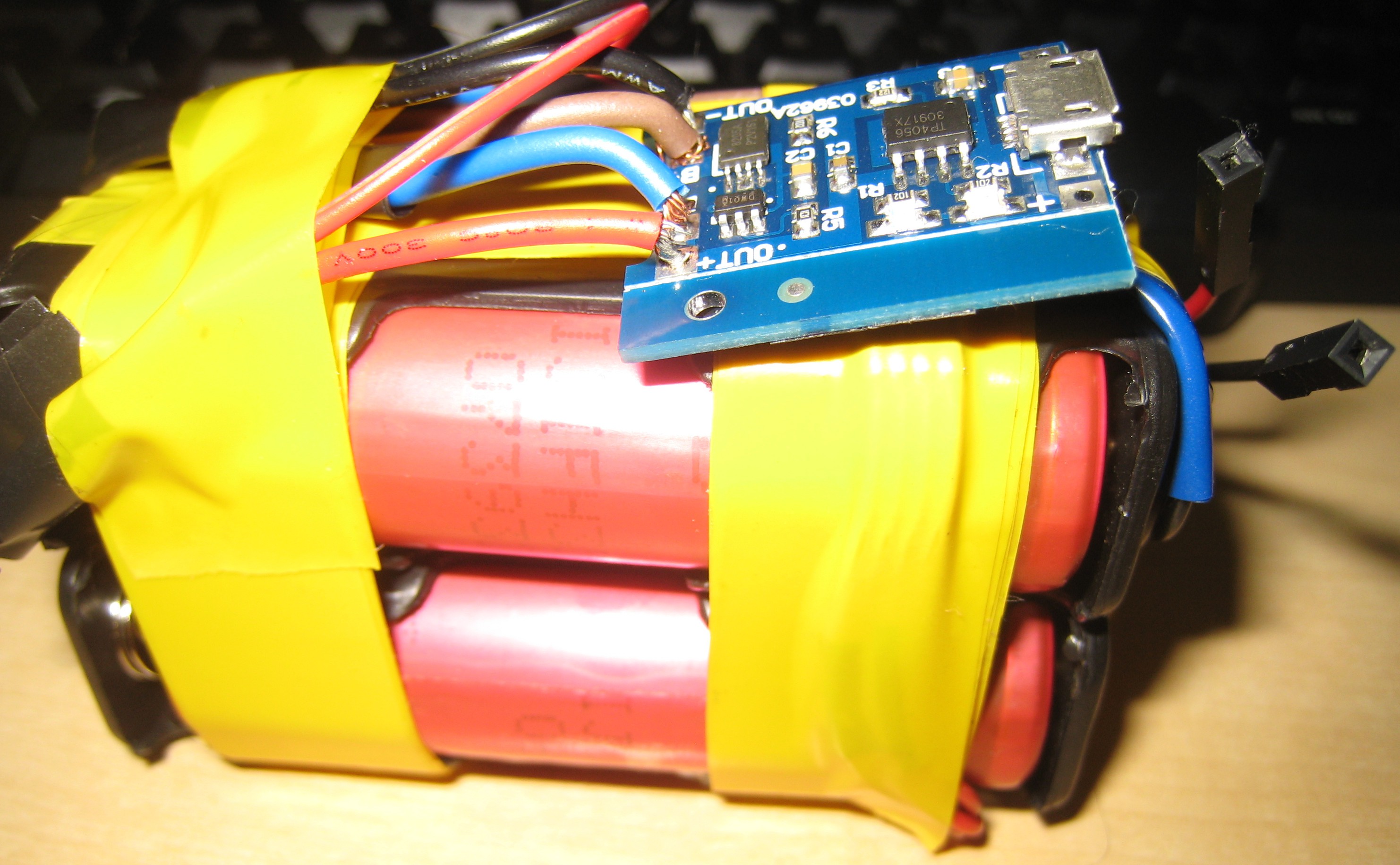
I have some of those charger boards, I use them with the old mobile phone batteries.
But Now I think about it, I have some old laptop batteries which I could dissassemble, however quite often the battery pack on old laptops has lost a lot of its original capacity (though this seems to vary,… I have an old Dell where the battery pack is useless, but the same age of HP laptop – around 10 years old the capacity is still fine, but on a sony laptop from about 15 years ago, I had to replace the battery after around 6 years)
I have some of those charger boards, I use them with the old mobile phone batteries.
But Now I think about it, I have some old laptop batteries which I could dissassemble, however quite often the battery pack on old laptops has lost a lot of its original capacity (though this seems to vary,… I have an old Dell where the battery pack is useless, but the same age of HP laptop – around 10 years old the capacity is still fine, but on a sony laptop from about 15 years ago, I had to replace the battery after around 6 years)
I think I may well give it a go, but I would suggest an in line fuse and or MOV/Zenner/Crowbar type protection, to limit the possibility of thermal runaway from short circuit. I know LiFePO4 cells are not as much pyrotechnic fun as LiPo, but they can still convert a large number of amps in to a large quantity of heat very quickly.
How did you manage to source that specific type of lithium battery. I looked on eBay etc but most vendors dont list the specific chemistry
The thing i worry about with lithium cells is discharging them too much, as i thought that permanently damaged them.
I wonder what the current consumption curve is like on the ESP8266 and the STM32, e.g. is there always some residual resistance that will end up flattening the battery to the point of ruining it, if for example it doesnt get charged enough from solar, either due to a week of very cloudy days, or the solar cell failing, or dirt getting onto the cell etc etc.
<…>
Thanks.
I think I was searching for the wrong thing on eBay. Unfortunately Amazon Australia only sell books, (too few people here for them to bother selling anything else).
So eBay and AliExpress are my only options for reasonably priced items. I can but locally, and there is a good local electronics shop (chain), which I frequent on a regular basis, but who are 3 or 4 times (at least) more expensive than any form of internet purchase.
I think they sell single cells for $20 !
I think they sell single cells for $20 !
Unfortunately its hard to know whats in the ALDI or Bunnings DIY store ones, unless I buy one and open it.
I was thinking of buying one anyway, to light the BBQ, so if I can open it, without destroying it, I will.
Edit.
They are much cheaper on AliExpress e.g
http://www.aliexpress.com/item/Purple-c … 71305.html
but goodness knows what you’d actually get.
<…>
http://www.aliexpress.com/item/Purple-c … 71305.html
but goodness knows what you’d actually get.
http://www.ebay.co.uk/itm/LI4-6-Ultrama … 19fa52ff1e They are a bit more expensive than single cells of course, but they are might lighter weight than lead acid, and physically smaller for the same or greater Ah capacity.
I suspect they will take over from lead acid in automotive, marine and UPS applications.
EDIT: Just spotted these 10Ah.. surely not..
but goodness knows what you’d actually get.
At worst case you get an “ultrafire” in your hand/garden/indoor, at best about a few hundred mHA see-> http://lygte-info.dk/review/batteries20 … %20UK.html
Ok, so let’s wire them in series:
This is interesting, they has very different current delivery capacity, i.e. it will be a very bad idea to use them in series with high power lights.
…and google “ultrafire explosion” for the rest.
If you wanna see what’s inside: http://budgetlightforum.com/node/30811
ok, … to become even more clearer: This man nearly lost his thumb, scroll into the middle for the pictures.
http://www.messerforum.net/showthread.p … xplodierte
!!!so, never ever buy thoose trust- or ultrafire batteries!!!
I bought them, they are ok, but not “ultra”cheap: http://www.aliexpress.com/item/Free-sho … 69830.html (I read all the feedback, tested the capacity myself, so they seemed to be legit)
LiFePO4 is a naturally occuring mineral and never has a lithium metal component during charge or discharge.
Ray
On an even more off thread line… maybe SolarImpulse 2 should swap to LiFePo4 http://www.popsci.com/battery-trouble-d … ower-plane
On an even more off thread line… maybe SolarImpulse 2 should swap to LiFePo4 http://www.popsci.com/battery-trouble-d … ower-plane
Unlike Li-Ion, there are only a few charging modules on ebay or ali:
The best price I found here (5.18 USD):
Unlike Li-Ion, there are only a few charging modules on ebay or ali:
The best price I found here (5.18 USD):
http://www.batteriesinaflash.com/lithiu … teries-6pk
Shipping cost reflect U.S.A address
Total Items: 1 Weight: 0.1lbs Amount: $12.95
Qty. Item Name Unit Total
1
Lithium Phosphate 3.2V 600mAh AA Rechargeable Batteries 6Pk
Sub-Total: $12.95
Available Shipping Methods Rates
USPS (First-Class Mail Parcel) $2.54
USPS (Priority Mail™ Small Flat Rate Box) $5.25
USPS (Priority Mail™) $6.02
USPS (Priority Mail™ Regional Rate Box A) $8.98
USPS (Priority Mail™ Medium Flat Rate Box) $11.30
USPS (Priority Mail™ Large Flat Rate Box) $15.80
United Parcel Service (UPS Ground) $11.74
FedEx (Ground Home Delivery (4 days)) $12.21

