
Check this one out.
It looks like its a sort of DigiSpark using STM32
But it is really expensive $23 assembled and $6 just for the PCB
http://www.ebay.com/itm/STM32-ARM-Ardui … 4adfd825f0
Data links to GitHub https://github.com/bobricius/Maple-Smar … cb-Crystal
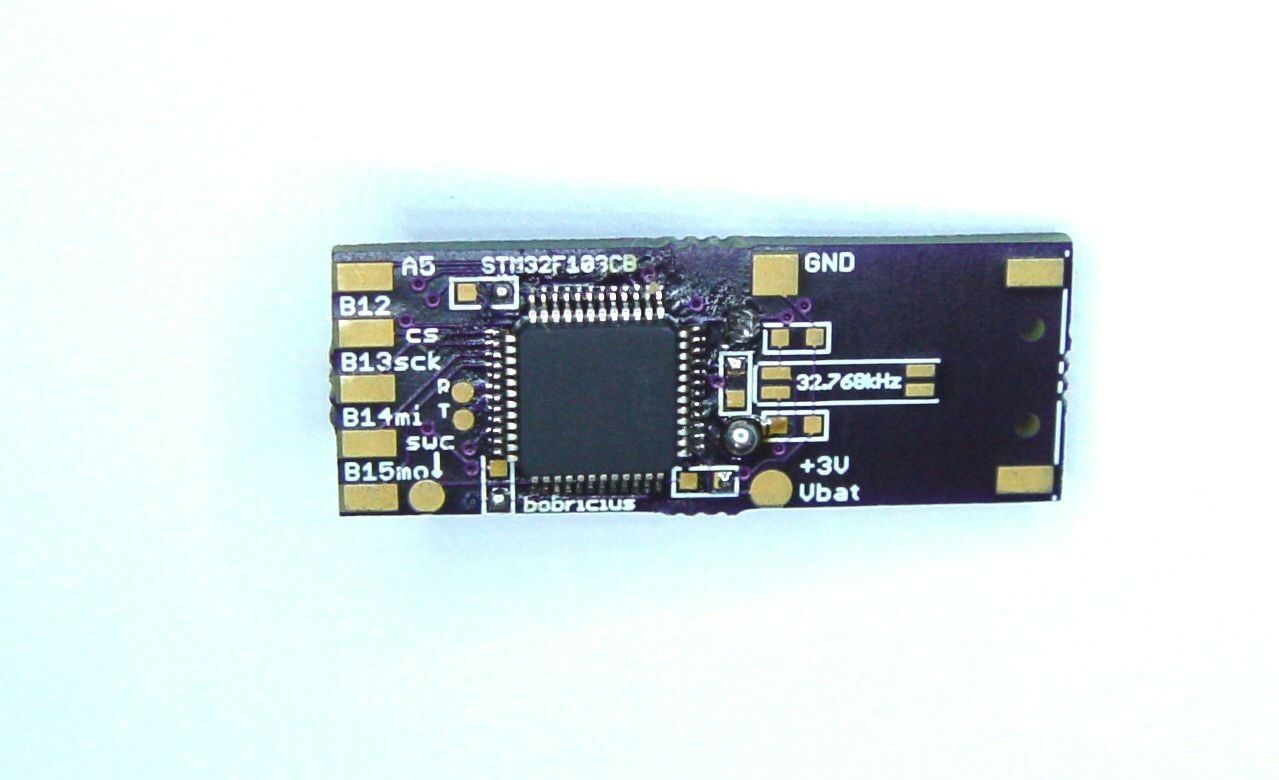
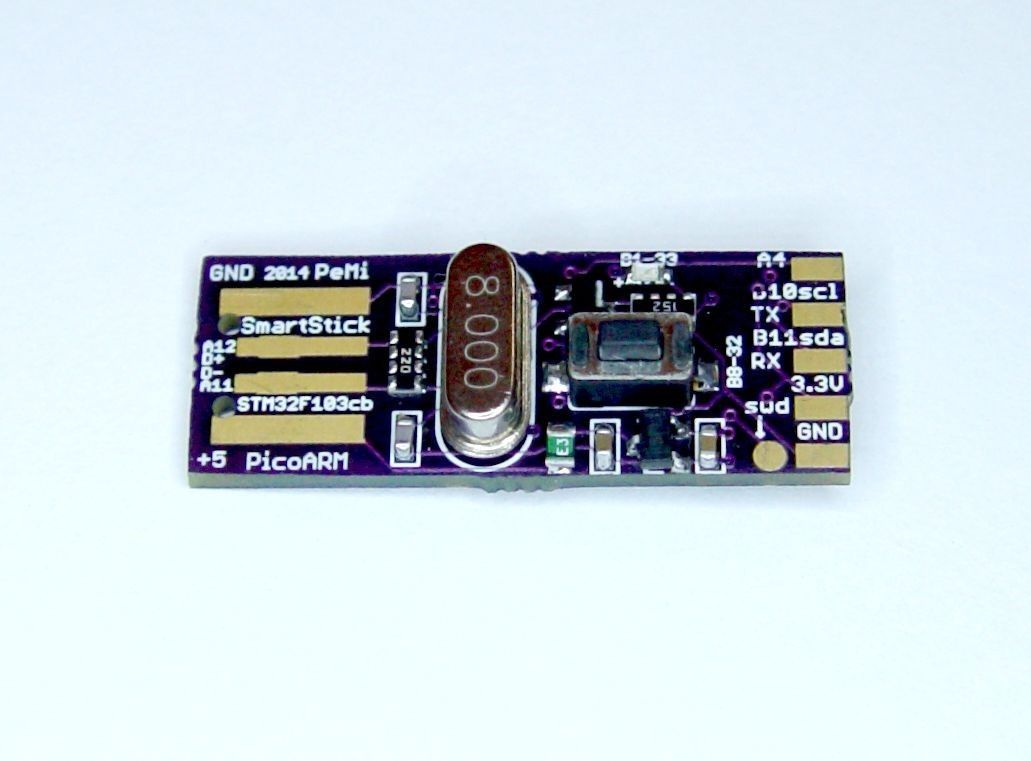
Claims to be Maple Mini compatible
$6 is really expensive for the PCB, especially as its OpenSource. We could easily get any of the PCB fab places to make a batch for $10
But of course assembling is the tricky bit with SM chips 
I prefer – as I posted on arduino forum – that we build a “community board” or PCB. With nice features like (jumperable) pullups for I2c, maybe a little bit bigger than the maple (50x50mm is a good choice, because it’s cheap to produce)
this (expensive) digispark one remebers me on majenko, he build a minimalistic usb-stick PIC32MX250, which is REALLY small

I saw this little board, but I’m not exactly sure of the purpose. There are only a couple of pins (I am seeing 5 GPIO?). Not sure I would bother with an STM32 that only has a couple of GPIO pins when I can get cheap tiny ATMega ot ATTiny setups. I can see how the processing power is nice, but still seems a bit small to me. That and I am always more interested in something I can easily battery bower than something with built in USB that is powering the board from 5v with a regulator. I would rather sort out the voltage myself for battery power.
Sure would be a neat trick to have RTC built-in.
mrbwa1 wrote:I like the idea of a community board: I think it would need to be 2 boards, because I am interesting in a small form factor board, however I can see a larger board being good too (especially if we get the STM32F4 support worked out).
I saw this little board, but I’m not exactly sure of the purpose. There are only a couple of pins (I am seeing 5 GPIO?). Not sure I would bother with an STM32 that only has a couple of GPIO pins when I can get cheap tiny ATMega ot ATTiny setups. I can see how the processing power is nice, but still seems a bit small to me. That and I am always more interested in something I can easily battery bower than something with built in USB that is powering the board from 5v with a regulator. I would rather sort out the voltage myself for battery power.
Sure would be a neat trick to have RTC built-in.
But you miss the point… the unit has embedded USB. This means that the board can cooperate with the PC software… native language, or Java as in Processing. It can also use the host PC as a gateway to the Internet and do Pub-Sub stuff. With many PC motherboards and Windows, one can wake up the OS from sleep by using USB (BIOS must be configured to keep power on USB and Windows must respect the request from device) so that HID keyboard can wake the PC. As a HID keyboard does not requires drivers under Windows, Linux, or OSX then one can see the appeal of this concept. Additionally, there is a HID keyboard Java application written by RaysHobby.net that allows 2-way communication so the device can be configured, etc. Once Adafruit employee Frank Zhao (USnoobie fame, Adafruit, now Sony Games) has documented this with their Pro Trinket device.
https://github.com/frank26080115/raysho … al-trinket Ray
I prefer – as I posted on arduino forum – that we build a “community board” or PCB. With nice features like (jumperable) pullups for I2c, maybe a little bit bigger than the maple (50x50mm is a good choice, because it’s cheap to produce)
this (expensive) digispark one remebers me on majenko, he build a minimalistic usb-stick PIC32MX250, which is REALLY small
I will add a board to the boards section. However I can’t do it this instance as I’m not in front of my PC
I will post later when its done
Ps, I recall someone on the Arduno.cc forum thread had made their own board, which perhaps we could use as a starting point.
Personally a Maple mini size board with a F103RET device is possibly the sweet spot, if we can squeeze the chip onto a board that small
rather hard. seems like it would take up the most of the breadboard, with only one pin available. And i didnt looked how many io pins it got. I could imagine something like the pro nano but bit wider. But would be possible.
~Straw
If I get time I will see if I can email or pm the guys in the Arduino forum that made their own board. I know one guy on GitHub made is own maple ret 6 I think
Hopefully he will join the forum
Sure would be a neat trick to have RTC built-in.
I can’t remember where I found it, but I remember the files were in Github.
https://ourduino.wordpress.com/2013/03/ … ni-part-1/
There are also several designs on this github, some of them for 64pin F103:
https://github.com/siy/openstm32hw
