
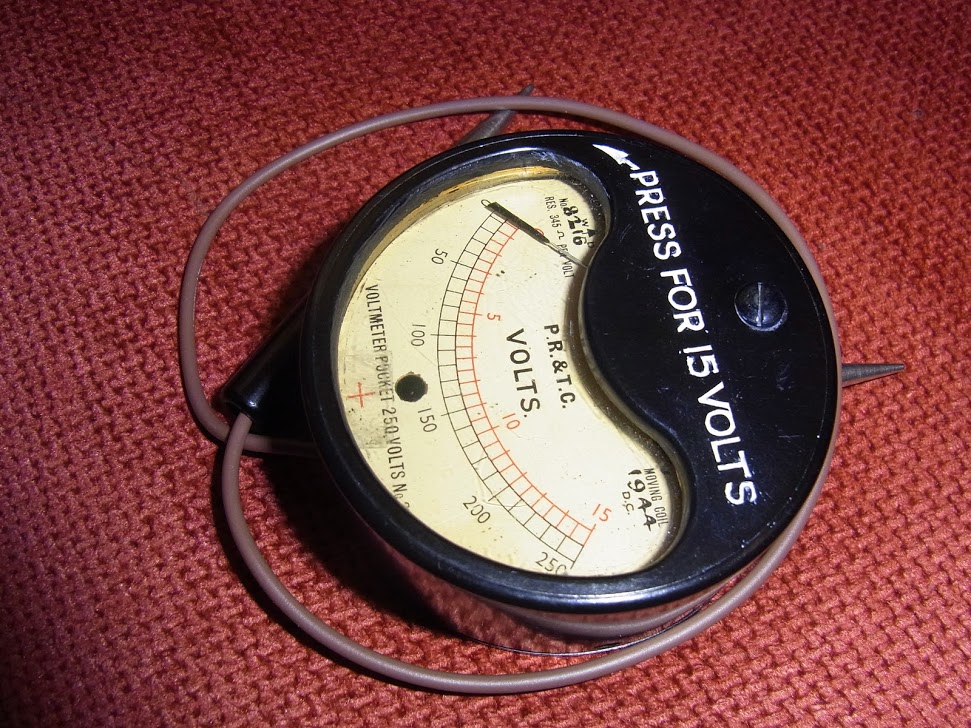
I had to replace the probe wire, which was hanging on by a thread, and made of rubber insulated wire, which was missing most of the rubber. The movement works, but one of the internal resistors appears to be open circuit, so it doesn’t actually measure 250V or 15V, yet..
I also brightened up the white lettering, so hopefully at least it should now pass muster as an “objet d’art”, rather than “just another bit of junk to clutter up the house.” 
Spec. is as follows.
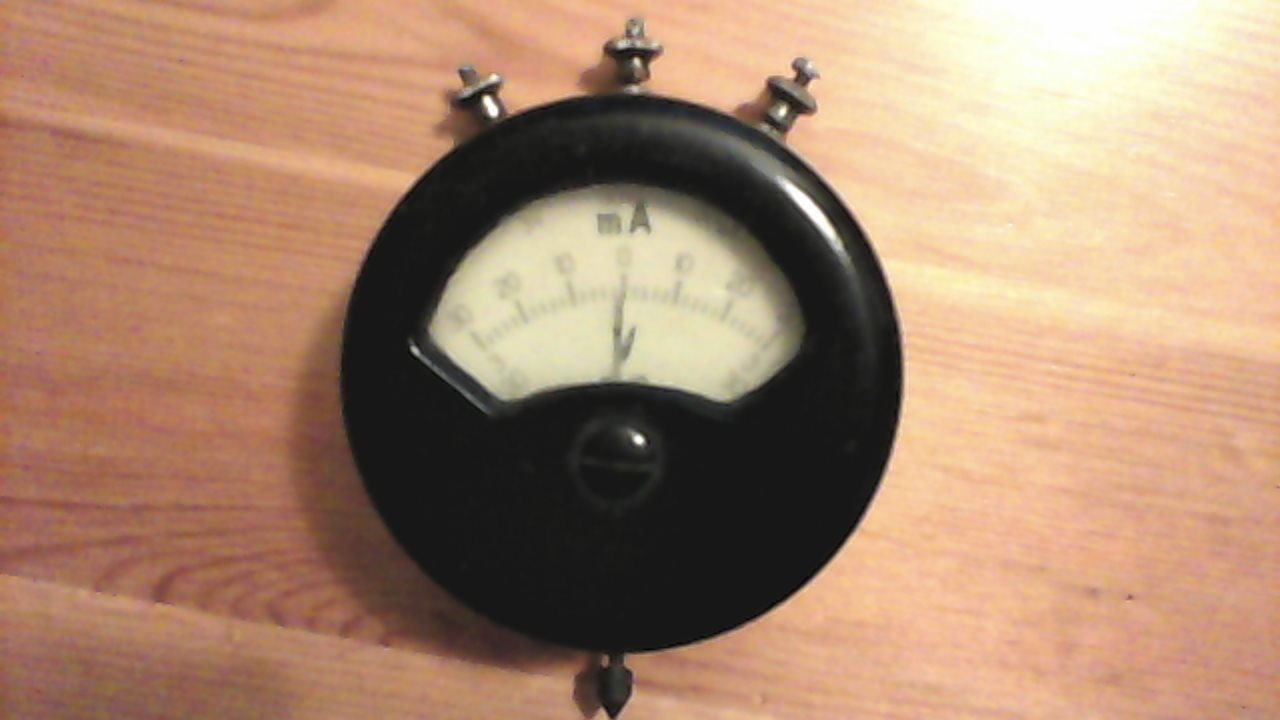
Bakelite Pocket Multimeter “Voltmeter Pocket 250 Volts No.2” Meter.
Mfd. 1944
Resistance per volt – 346 Ω per Volt
Sensitivity 0.002890173 A (fsd)
i.e. 2.89mA (fsd)
Estimated resistance at 250V ( 346 * 250 ) = 86500 Ω (86.5kΩ)
Estimated resistance at 15V ( 346 * 15 ) = 5290 Ω (5.29kΩ)
Now all I need to do is find the time to buzz out the internal resistors and fix the broken one, probably with a few carefully chosen smd ones hidden in a “piece of wire” link across the defective one.
Quick teardown is -> here <-
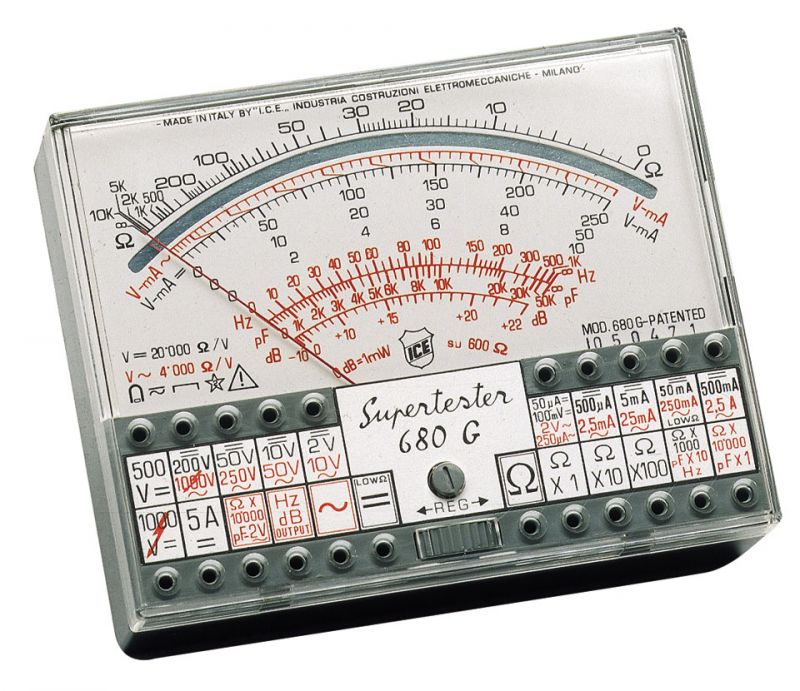
It was very common in Italy in the 70′ and early 80′ and you can still buy it as surplus.
First models used a 3V battery that you can’t find nowadays, the last revision used a 1.5V battery.
Since the battery was used only for resistors it works also without battery.
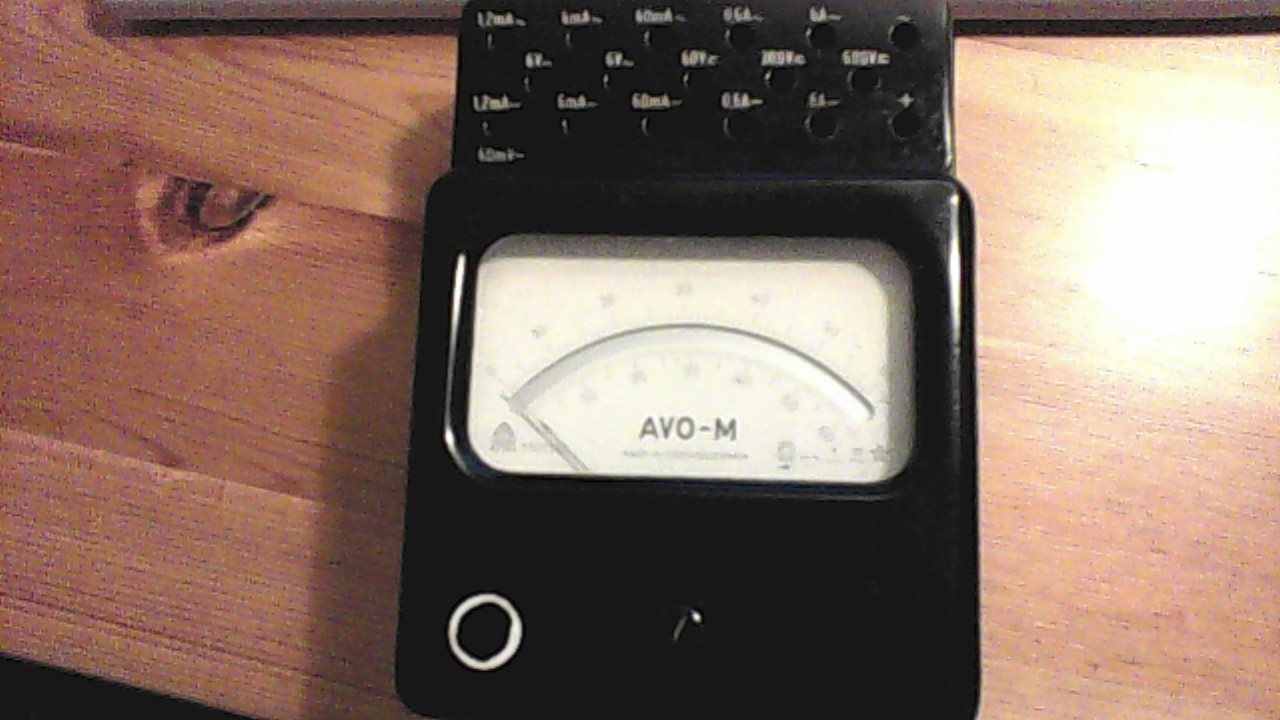
- Mon Sep 18 17-16-39.jpg (110.66 KiB) Viewed 863 times
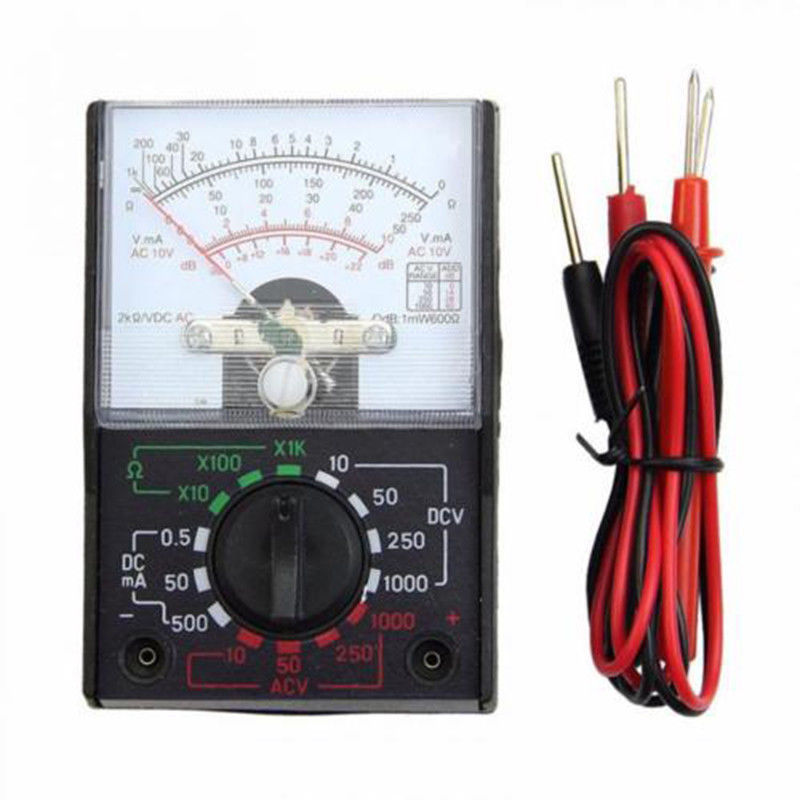
They appear to be even cheaper now than they were when I bought mine (and probably just as dangerous).
The second one I bought was a big ugly yellow brick of a thing that came from the “broken” bin at Tandy, and required a little bit of surgery to get it working. Since it was digital, it was a step up in the world (of sorts). It lasted many years, before eventually succumbing to the sheer awfulness of its build quality. It was a single sided paper and resin PCB, with hand drawn traces, fairly typical of the era, and for some reason it seemed to by hydrophilic, the tracks and components all gently corroded as the years went by.
I find it difficult to resist multimeters, especially ones with “odd” features. I now have a small collection of them.

saw original post and now thinking pendulum weight as on a clock

stephen
- Mon Sep 18 17-56-51.jpg (70.26 KiB) Viewed 848 times
[dannyf – Sat Oct 07, 2017 8:29 pm] –
I still have a 830 from the 1990s. have sinced gotten (more than) a few 830s as well, some for free. Best value for money, in my view.
There are a lot of snooty remarks about those cheap 830 multimeters. I’ve got a couple, and other than the crappy probes, I’ve never had any issues with them.
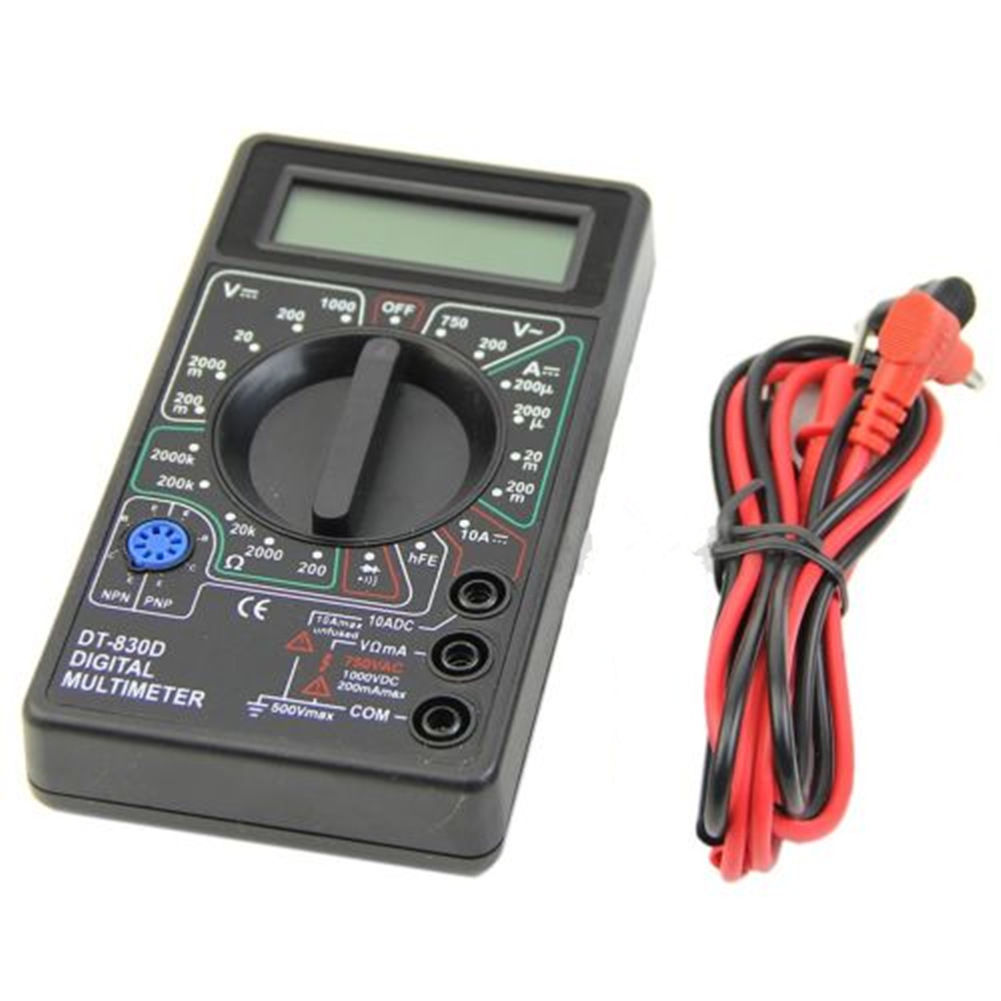
They are what they are, inexpensive and modestly robust. I wouldn’t rely on them for high voltage work, but for most other day to day things they are fine. At $2.78 a pop (pun intended) , they are almost disposable.
Some of them have a 200uA range which can be handy when building battery operated projects.
I recently picked up a ZT102, which is arguably the next step up from the ultra cheap 830 style meters.

I’m pretty impressed with the features, and it is actually better build than I was expecting for the price. 6000 counts and spot on accuracy for around a tenner. Not bad.
likely from those who focus on what their tools can do, not what they can do with their tools.

