
It is a KiCad project and release under CC BY SA 4.0. Here’s a 3D picture of the board:

- STM32populated.png (59.24 KiB) Viewed 928 times
By the way, I forgot to mention. On the back of the board is a silkscreened rectangle. You can cut around the rectangle with a cutting disc tool and remote the labels on the outside of the board so it can fit mostly in the same footprint as the original board except for the part that sticks out for the USB, which is usually sticking out over the edge of the PCB I put it on anyways. Just be careful not to cut the traces on the edge or you will have to jumper them with wires.
Dan
Also, the analog/digital powering and grounding tracks have to be layout carefully, otherwise your adc readings will be too noisy.
BTW, there is not such a chip like F104 available so far.
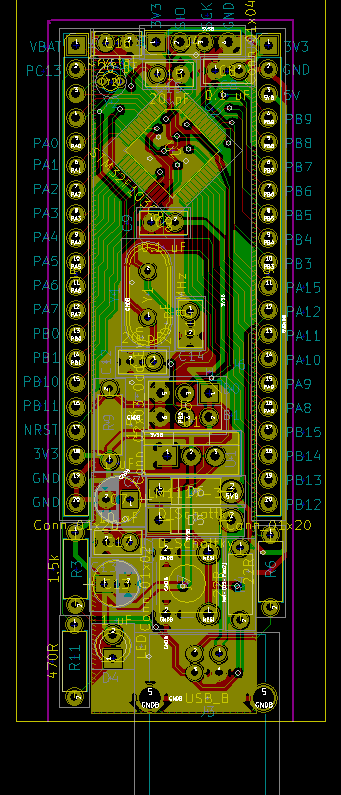
- stm32f103 board.png (55.71 KiB) Viewed 838 times
https://drive.google.com/open?id=1wGwwu … 6fntMrBHum
Here’s a picture of the board with and without components:
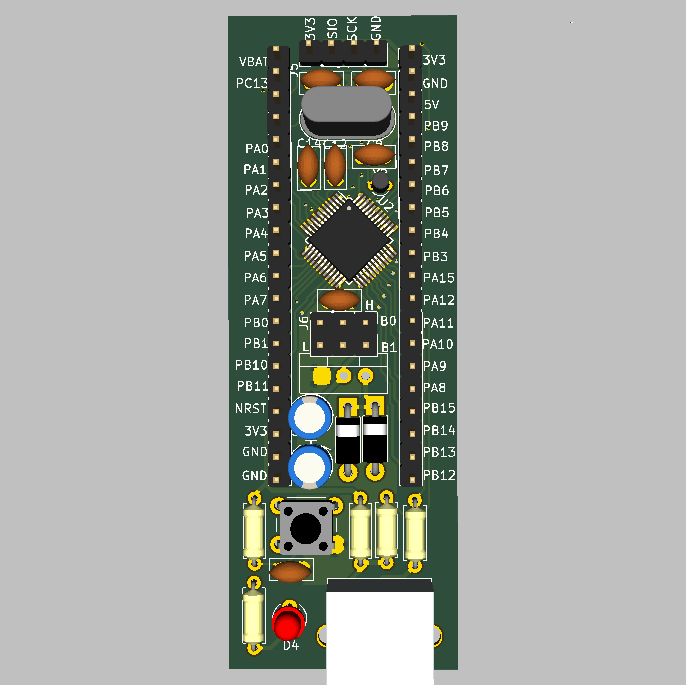
- STM32alt-populated.png (51.18 KiB) Viewed 769 times
Here is a picture:
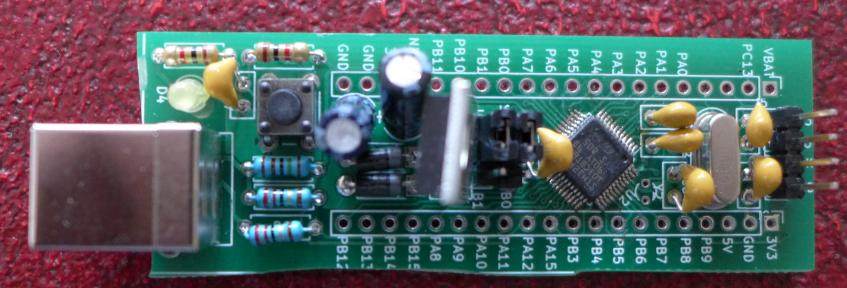
- P1100845.jpg (44.65 KiB) Viewed 650 times
impressive work, perfect welding, Thank you for sharing.
< $1.85 delivered in 10 qty
My goal is to use thru-hole components (except for the STM32F104 of course) and as generic of components as possible. This way this can be assembled at home from spare parts, or incorporated into larger projects.
There are many reasons to design a blue-pill clone using thru-hole components, but the BOM will never be less than $1.85 assuming you buy quality parts in hobby quantities and not using left-over “unvalued” parts (even a free part has a replacement value.) If you have access to extra parts, it may be a fun experience for the first 10 or so boards, but most forum members complain about never having enough time, so one must take the value of time into consideration – my opinion.
Unlike SMT parts, thru hole components can be damaged by careless manual soldering, often causing the parts to shift value. SMT w/ hot air are designed to maintain tolerance provided the temperature heating-cooling cycle is not abused.
I’m not trying to distract from the success of your effort, simply to suggest that for 99.9% of hobbyists, there is no such thing as a totally “free” parts supply. But, the value of learning to design a working board from software, to layout, to validation, to ordering, and to assembling the (working) board is a valuable experience. Therefore, I applaud your efforts.

- .
- clapping-hands-gif-11.gif (10.99 KiB) Viewed 611 times
One of the benefits of the Arduino is that everything about it, down to the Gerber files to make the boards yourself if you need to, are available. The same is not true of the BluePill. Now the version I designed is available and can be used to reproduce the BluePill if needed. Yes you can buy one for $2, but you can make one yourself should that be necessary or desirable. Besides, I fixed the USB resistors and added Schottky diodes for the power, and you can put a bigger power regulator on it if you want to use the 3.3 volts for other things. The open design is what made the Arduino successful in the first place and if there’s going to be a commodity 32-bit alternative, that also needs to have similar open-source and open-hardware options.
Dan

i suppose the mcu is after all a stm32f103 as f104 don’t seem to be a valid sku
https://www.st.com/en/microcontrollers/ … tId=SS1031

