
https://www.hackster.io/rayburne/lora-a … p32-6ce9ba
Ray
And now we will try to map it…
I still did not find some low power loraWAN code for this ESP32 boards…
And you are really close 
[goran.mahovlic – Wed Feb 21, 2018 10:32 pm] –
I never manage to do that, but they say that you could burn receiver if you are to close to sender.And you are really close
In a well designed board, the RF input should be protected, even if the send unit is adjacent … as in my test picture.

stephen
Logging humy and moisture in every room for a years on small battery is quite nice.
Having GPS in bike or car is a nice feature to.
Maybe pager SMS-LorA for display versions.
There is lots of examples where it would be usefull.
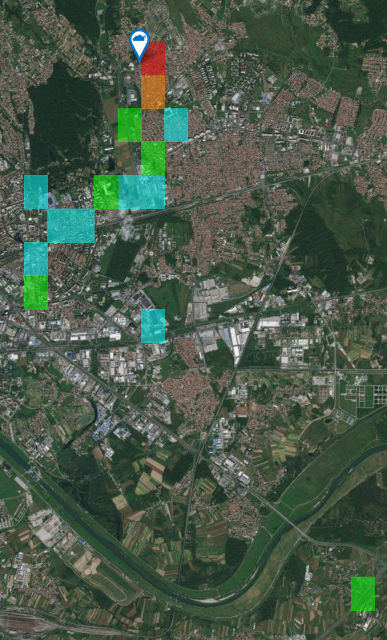
Here is some mapping – home <> work for a few days now
- Maping.jpg (73.32 KiB) Viewed 847 times
Do you maybe know good low power CO2 sensor?
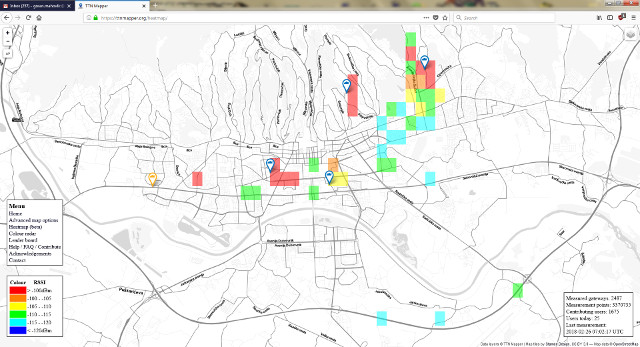
here is weekend mapping of my city that we did on my lora workshop…
- Mapping5.jpg (73.42 KiB) Viewed 751 times
[goran.mahovlic – Mon Feb 26, 2018 8:44 am] –
wow looking nice
Do you maybe know good low power CO2 sensor?
…
CO2 sensors are rather expensive and have a limited life. You may be better off purchasing a CO2/smoke detector and cannibalizing the CO2 element  Around Atlanta, I have seen WalMart and HomeDepot all selling the devices under $30 and sometimes as low as $20.
Ray
[asmallri – Mon Feb 26, 2018 10:21 pm] –
The SenseAir sensors I am using are not too expensive ($120) and have a 5 year life. They have performed consistently well during 12 months of testing.
Amortized to $24/year, I would say that the first-cost expenditure is the hard part to swallow. The forum fights over a $1 difference with clone boards
[goran.mahovlic – Mon Feb 26, 2018 8:44 am] –
Do you maybe know good low power CO2 sensor?
I am testing this one
http://www.eltsensor.co.kr/2016/product … S-300.html
In Italy it is about 100€ but I find similar NDIR CO2 sensors on Aliexpress at about 20€ but never tested them.
For LoRa CO2 I realy want to consume as little power as possible, so sleep mode with 0.5mA is to much.
What I usually do with other sensors is power down and up with FET.
But some CO2 have long first start so I need to wait a long time in wake state for CO2 to get ready.
And other thing with CO2 is re calibration – I need some sensor that I do not need to calibrate (if possible)…
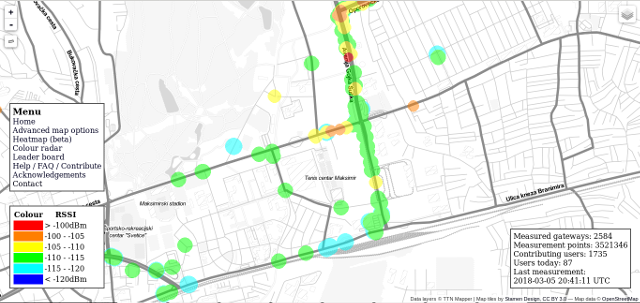
does the colour represent signal strength ?
where is the measurement point, centre of the rectangle ?
srp
There are many spots if you zoom into rectangle area.
And every spot is signal strength at that spot.
- Spots.png (161.78 KiB) Viewed 368 times
About power consumption: a standard USB port 2.0 is not able to power an Arduino connected to this sensor, the sensor reboot continuously. I use a power bank.
About long start: unfortunately NDIR sensors require some start time (if you want a great accuracy and precision) but I discovered that it is the same using electrochemical sensors like the Figaro. These sensors are commonly used in alarms ( some of then can drive an alarm and you can set levels) so they usually stay on all time.
Maybe laser sensors can work on demand but they are not cheap.
Calibration: calibration depend on what you need, great precision need calibration for all instruments. S-300 uses the standard atmosphere as zero so it need that is exposed to standard atmosphere sometimes, don’t work well in atmospheres were CO2 is constantly above the (actual!) standard of about 400 ppm.
I have some Gascard made by Edinburgh Instruments, their cost is about 1000€ but they require a more precise calibration using a gas without CO2 (nitrogen, for example) and a gas with CO2 concentration that is known. Once calibrated you can use them in all stable concentration but they are power hungry!
Electrochemical sensors are less precise, they require a better calibration because signal is influenced by temperature and humidity (you have to measure them) and are sensible to a gas group not only one like NDIR.
..
I made 2 STM32 LoRa nodes. One using a BP and the other using a Maple Mini.
Both are ultra small, as I use hot glue to attach the LoRa module directly to the underside of the boards , neither of which had the pins soldered to them.
My LoRa modules just have the spring antennas, so the whole setup is quite compact.
If I get time, I will find where I put both of them and post some photos…
I did some basic testing by making a sort of ping server on one of the and a ping client in the other, so I was able to walk around the neighbourhood with the ping client running from a battery flashing it’s led every time it got a response to its ping.
Performance was far better than I get using other FSK or AM RF modules, and for future projects I will use LoRa in preference to devices like the nRf905
[RogerClark – Tue Mar 06, 2018 8:46 pm] –
…
Both are ultra small, as I use hot glue to attach the LoRa module directly to the underside of the boards , neither of which had the pins soldered to them.
…
I have used successfully the “industrial” version of Velcro (hook and loop) tape strips and “dots” for such things. It has the added advantage of offering the “easy removal” attribute without resorting to a blow torch. Velcro tape is sold at most “office” supplies or via the Internet.
https://www.amazon.com/VELCRO-Brand-902 … ref=sr_1_7
Ray
I actually find hot glue relatively easy to remove. I use my hot air reflow tool set to 100 deg, (its lowest setting), and it melts the glue so that I can usually work in from the edges and remove the item in question.
I also find the reflow tool good to tidy up the hot glue as you can move it around by blowing on it, and it nicely smooths out things.
https://makezine.com/2010/10/28/simple- … g-hot-glu/
Will any alcohol do, or does it need to be ISOPROPYL
[goran.mahovlic – Wed Mar 07, 2018 9:57 pm] –
You can use ISOPROPYL alcohol to release hot glue joints …
https://makezine.com/2010/10/28/simple- … g-hot-glu/
News to me!
Drug store sells 90% IPA, but I bought 100% many, many years ago and still have some.

