
http://tech.scargill.net/esp8266-as-an-access-point/
If this works as stated, it could be very interesting!
Ray
I hacked together some code about 5 months ago, for a prototype / demo IoT device for enviromental monitoring, which could be switched to and AP and ran a web server, which allowed the device to be configured.
After configuration was complete the code switched the esp8266 back to being a Station and connected to an AP and started to send data to a php script I set up for testing
I presume that the Arduino version of the code also has the same functions, though I did notice that there were issues with the web server on Arduino, as its web pages are compressed into a single data file, and the Arduino IDE seemed to have issues uploading multiple files. But that’s a different issue and the pages data could be uploaded separately / manually
<…>
I wasn’t using the at command set, in order to use the AP, I was programming the device its self using the API into the OS.
At the time I had to use the special Linux VM to compile, but you can now do the same thing using the Arduino IDE.
Programming for the ESP8266 is not the same as the STM32 or ATMega devices, as your code just get called by the OS in response to events. I think the loop() function on ESP8266 is actually called on a timer interrupt, so doesn’t get called as often as on AVR boards etc
I think the AT commands may be OK up to a point, but I didnt bother with them, after having a lot of problems with some older TLN13AU06 “UART wifi” boards
I have some code elsewhere on github I wrote for those older boards, but getting them to be a web server was a nightmare.
Apart from having to learn a new language (possibly), there is also the Lua firmware for ESP8266, which is actually quite a good option for small projects because they have compiled in a load of extra stuff so that (I think) there is built in web server, and other interesting things
Prior to the Arduino core, I had considered shifting one of my prototypes from using C to using Lua (but Id have to learn Lua)
Prior to the Arduino core, I had considered shifting one of my prototypes from using C to using Lua (but Id have to learn Lua)
Yea, that was my thought although Nick Gammon is a big Lua fan:
http://www.gammon.com.au/scripts/?bbtopic_id=113
At-The-Moment, I’m more interested in “getting” from the net than serving up an IoT sensor. My thinking is immature at this time due to lack of experience. It is amazing at the time one must expend on this $3 board! Just look at the manhours in the $4 Maple Mini.
Ray
Cheap boards seem to have less support from the manufacturer, which makes sense really, in terms of their profitability. – UNless its a big company doing a loss leader.
I suspect the ESP8266 is going to be easier to get working than the Cypress PSoC
 That has already proven to be the case! But for all the hassle, the PSoC 4200 redemption is in the analog fabric that can be constructed from the resulting VHDL… it is a glorious feeling to be able to drag and drop an OpAmy, drag and drop an Analog Mux and then wire this stuff up virtually, assign a pinout through the analog switch fabric… Vola…. flash the composition and continue.
Ray
I guess I really must bite the bullet with the PSoC at the risk of bricking it, as drag and drop analog circuits sound very appealing.
I guess if the worst comes to the worst, I’d just need to get hold of an external programmer for my PSoCs, ie if I stuff up including the bootloader.
Ps.
Which esp8266 do you have. If its the $3 one with 8 or 10 pins in two rows at one end, I’d recommend you put the bigger ones on order. E.g. Something lik the ESP07, as you get a lot more pins including ADC
I guess I really must bite the bullet with the PSoC at the risk of bricking it, as drag and drop analog circuits sound very appealing.
I guess if the worst comes to the worst, I’d just need to get hold of an external programmer for my PSoCs, ie if I stuff up including the bootloader.
Ps.
Which esp8266 do you have. If its the $3 one with 8 or 10 pins in two rows at one end, I’d recommend you put the bigger ones on order. E.g. Something lik the ESP07, as you get a lot more pins including ADC
Thanks
I was wondering if I could program / upload using one of my many other boards 
I have quite a few different programmers, e.g. JTAG clone, as well as an 8051 programmer (Texas Instruments) and of course stuff for AVR, but none of them e.g. the JTAG seem to list the PSoC as an option.
Though I’ve just read that perhaps the JTAG (ARM) can do it, but not directly from the cypress IDE
So its good to know I can program one of my PSoCs as a programmer if necessary. I bought 4 and gave one away, so I have 3 left.
Re: ESP8266
I started off with the ESP01, but soon realised that it didn’t have all the pins broken out that you normally need. So I bought a variety of different ones, including the nice white boards you mentioned. However I’ve not got around to using the nice new shiny white ones yet.
It’s adequate, but I had to reverse the I/O pin connector which is normally facing down with the headers because it will not fit into a breadboard otherwise! (I did see some folks creatively bent the pins at 90 degrees but that surely puts stress on the fiberglass. Someone in China had a very bad Monday when they designed the layout.
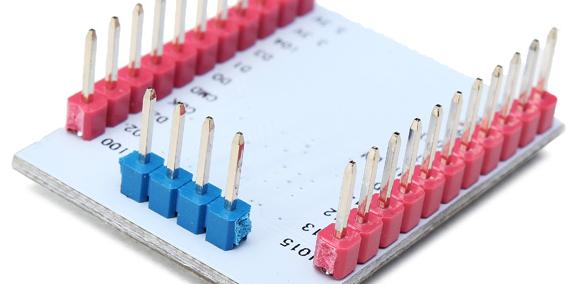
- UnModified.jpg (19.63 KiB) Viewed 726 times
So its good to know I can program one of my PSoCs as a programmer if necessary.
Remember, the trick does not apply to the less capable PSoC 4100 prototype board, just the 4200. While Cypress sold the 41/4200 both for $4, the 4200 has enhanced analog capabilities and an overall better feature set. (I’ve often wondered if life starts out as 4200 and then if the yield is low, it gets tested and re-branded as 4100?)
For anyone reading that is not familiar with these little boards:
http://www.cypress.com/?rID=92146
Note the break-off section of the board, this is the USB-serial section.
The full Cypress Creator software and standard libraries (newlib is used for the M0+ ARM core) system is freeware. If you were like me and had never worked with configurable silicon, Creator hides the VHDL with a graphical drag-n-drop metaphor, but the learning curve was rough on me due to having to go to numerous options for required configurations.
One can get a little creative with how the header pins are attached (headers NOT included):
https://www.hackster.io/rayburne/psoc-4 … ture-book1
Ray
I’m pretty sure my PSoCs are 4200 serial, but I will double check
But it’s all the other analog hardware blocks and interconnectivity in them that make them interesting
But it’s all the other analog hardware blocks and interconnectivity in them that make them interesting


