
I’ve been updating some old hifi amplifiers and “ghetto blasters” etc to have bluetooth audio playback, by using a USB Bluetooth dongle like this one
https://www.aliexpress.com/item/3-5mm-S … 5c131f0978
Which I take apart, remove the USB plug and 3.5mm jack socket, then solder the board inside whatever I want to upgrade.
Well, I noticed that some of these have a Winbond 25Q40 SPI flash chip on them (as seen in this photo)
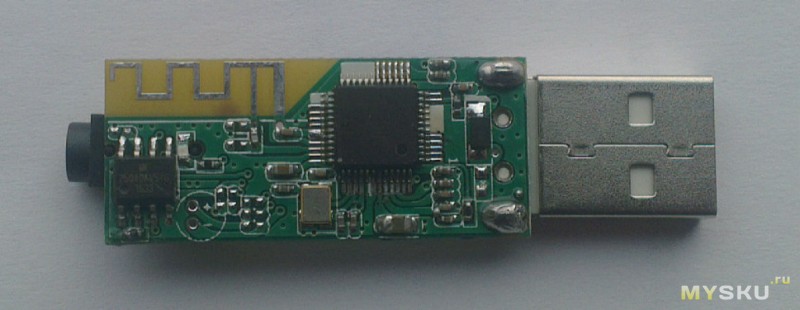
Which either contains firmware or settings for this device.
As I now have several devices I have upgraded, I was hoping to possible read the settings and specifically the name that it it appears as, so that rather then all appearing as YET-M1, they could be named something unique, e.g. KenwoodHiFi, so my kenwood amp, or “Sony Portable” etc
Actually names longer than YET-M1 may not be possible, so I may need to limit it to 6 chars, but I’m sure I can think of some suitable names e.g. “Office” or “Knwood” etc
However I’d first need to read out the entire contents of the Flash to see if I could find where that string was located, and then update that portion of it.
I could remove the whole IC, but it would be good if I could perhaps just disconnect the Vcc line, and power it in isolation from a Maple mini (and connect the other pins to the Maple mini)
I’m not sure if that would work, as the other signals would still be connected to the bluetooth chip.
Also, I’d need to find a library for these Windbond SPI chips
But it would be a nice hack if I could do this.
One note about these dongles. They don’t all contain the same hardware.
Some I have look like this
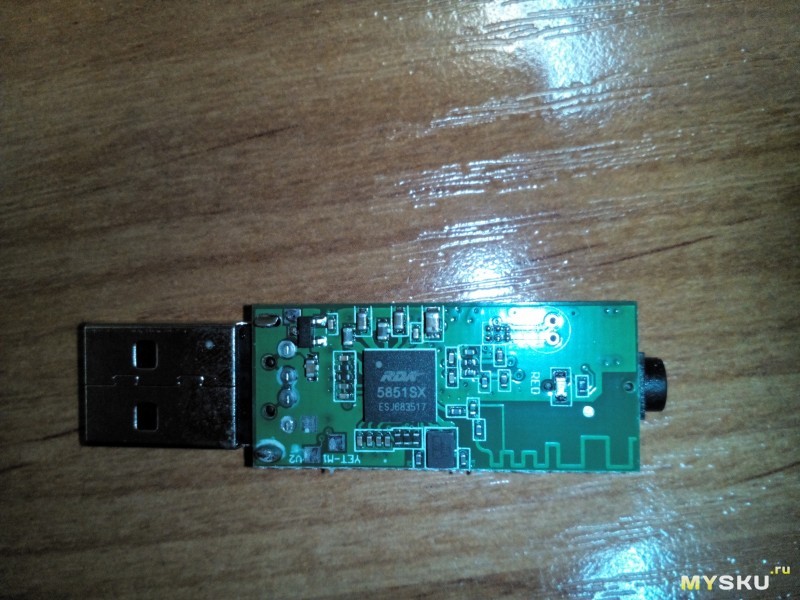
And don’t the SPI flash. (Well they may have a SPI flash but if so its surface mount and would be much harder to modify)
As a side note…
I’m also adding USB audio inputs to some things, using a dongle like this
https://www.aliexpress.com/item/2016-Ne … 66b1851b71
They seem to have a CMedia chipset, which works fine on Windows and also on Linux (but does not work now on OSX El-Capitan as Apple removed the drivers for it (arrgghhh))
These are even easier to install, as they can take their power from the PC, and all you need to do is take them apart and remove the USB plug to save space, and I use a cable like this
https://www.aliexpress.com/item/USB-2-0 … 2f5baa7d99
(IMPORTANT, This cable has the Red and Black wires the wrong way around, Red is Negative, Black has 5V if you cut it open !!!)
or
https://www.aliexpress.com/item/Brand-N … 2f5baa7d99
and cut off the USB plug, and solder the wires to the USB adaptor, then cut a hole for the panel mount socket and fit it
This Arduino and esp8266 library works with many winbond flash chips.
Never tested.
I am waiting for a soic clip to see if it works on soldered chips.
I’ll give that a try
But, I had a bit of a problem with the board with the DIL pin chip, as I found that its power GND is not the same as its audio GND (output)
If I connected audio GND output to the input GND, it took a lot of current (through my analog meter) and reset the dongle ;-(
So I can’t use that specific model in my amplifier unless I can generate and isolated supply for it.
As I wanted to get the amplifier working today, I’ve used the other type of dongle board (which doesnt have the DIL pin chip).
I’m not sure whether this other dongle uses external SPI flash at all.
It has another SMD chip which is labelled D296L, which may be SPU flash, but its a SMD part with all pads underneath, so would be much harder to update 
The Bluetooth chip is a RDA5851S
https://www.mikrocontroller.net/attachm … A5851S.pdf
Which has onboard flash memory
But I guess there must be a way to program or perhaps read back this memory (though its probably read protected )
It would be great to be able to dump out my sensor definitions to an external flash device – so that users can configure startup behaviour.
Nice find!
Are these winbond device as cheap as chips? 
To get started with that project I had had the pictures stored in the flash chip. For that, I used a Russian software (with google translation) combined with an arduino.
With that software you can read or write a variety of winbond 25QXX flash chips.
- SPI Flash programmer.zip
- (118.13 KiB) Downloaded 71 times
When I get chance I will see if I can access that Winbond chip.
But I also found another problem with using these Bluetooth audio receiver dongles, because their audio output has a lot if background noise, which sounds like typical microprocessor noise.
So I will need to see if there is a way to add extra decoupling, and see if I can reduce this.
I’ll do a tear down and also see if I can read the flash one of these days (if I manage to find some spare time of course).
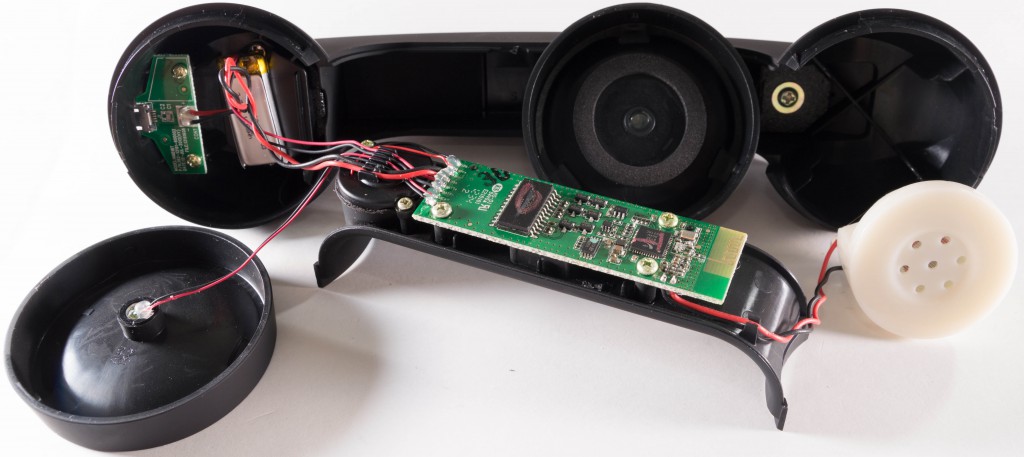
(Image courtesy of Dr Gough’s Tech Zone http://goughlui.com )
They are actually quite useful without taking them apart, the bluetooth range is reasonable. The built in lipo and charging circuitry is a bonus. They work perfectly with Linux too (doesn’t everything these days?)
EDIT: The BC6130 CSR chip on this device is a relative of this -> https://cdn.sparkfun.com/datasheets/Wir … asheet.pdf —I have yet to find the full datasheet for the BC6130 though.
EDIT: Datasheets for both the BC6130 and BC6140
http://pdf.dzsc.com/99999/2013328171912704.pdf
http://pdf.dzsc.com/99999/2013328171936507.pdf
I think more things worth with Linux than they do with Windows.
I was hoping to be able to play via Bluetooth from my W7 machine to my Hifi amp with the BLE receiver in it, but despite trying 2 different USB Bluetooth dongles (one old and one virtually brand new). Windows does not recognise any Bluetooth devices at all.
So my use of the receiver in the amplifier will be limited to playing music from my phone though it.
So I want to read the entire 8M flash (a Winbond one like the others here) and I am waiting the end of the chinese New Year to buy a SOIC8 clamp., Then I have to wait until it will arrive here….
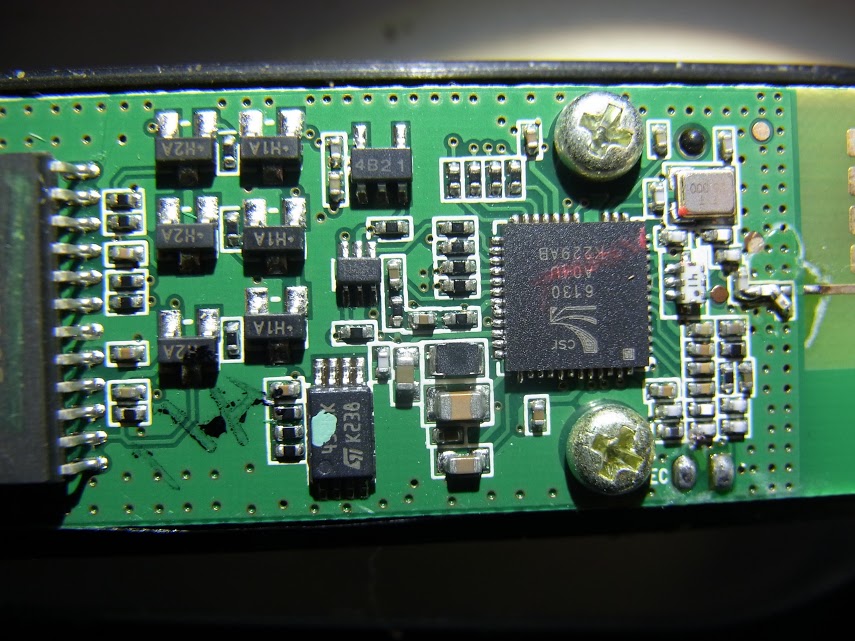
… and an unidentified 24 pin chip marked WE3P085 .
Does anybody have any clues what it might be? One possibility is that it may be an 8051 based soc… but it could be pretty much anything.
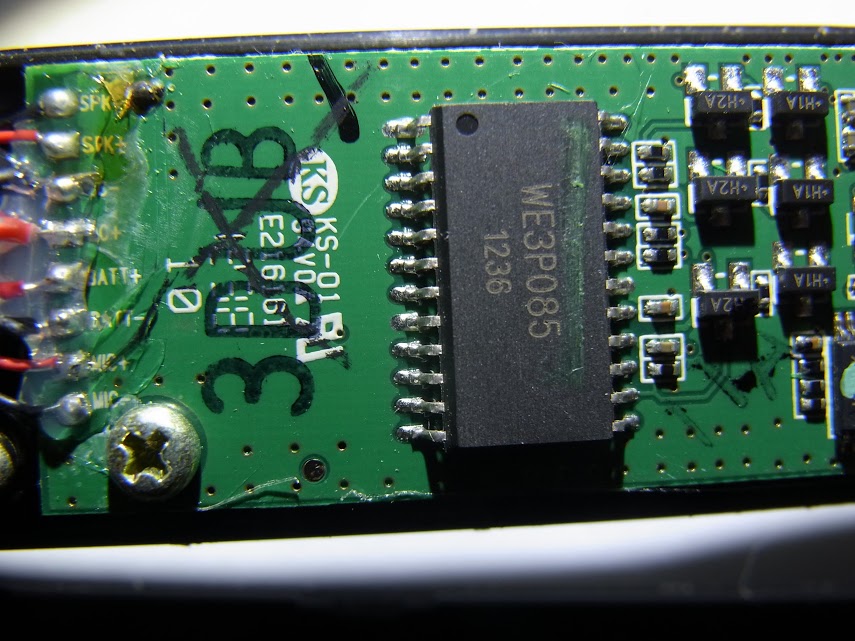
It also breaks out a UART debug interface on pins 18 and 19 of the BC6130 … if I get a bit of spare time I’ll tack a couple of wires to those pins.
But the cost of the full CSR IDE / compiler was extremely expensive, so I decided it was not worth playing with.

… and an unidentified 24 pin chip marked WE3P085 .
Does anybody have any clues what it might be? One possibility is that it may be an 8051 based soc… but it could be pretty much anything.
I finally got rid of the CPU noise that appeared to be coming out on the audio lines
The problem transpired to be supply voltage noise. So I’ve put a 1000uF and 100nF cap in parallel with the 5V input, and I’m using an 18 ohm resistor in series with the incoming 5V (18 ohms was all I had hanging around, as I was going to use 10 ohms)
Just putting the capacitors across the module didn’t help, I definitely needed to add the resistor.
I also removed the LED, that just seems to flash and doesn’t give much indication about whether the module is paired or not. (as it seems to flash in either case), because the LED takes 20mA and this causes a volt drop on the input, which you can hear as a ticking sound.
I know this is irrelevant to my original post, as I’m no longer using the dongle with the Winbond chip, but I thought I may as well post about how you can use these at least to play audio into an old HiFi amplifier
BTW if you do decide to try to hack this particular device, the manufacturer has kindly broken out all of the pins you need to hack it on the reverse side of the board.
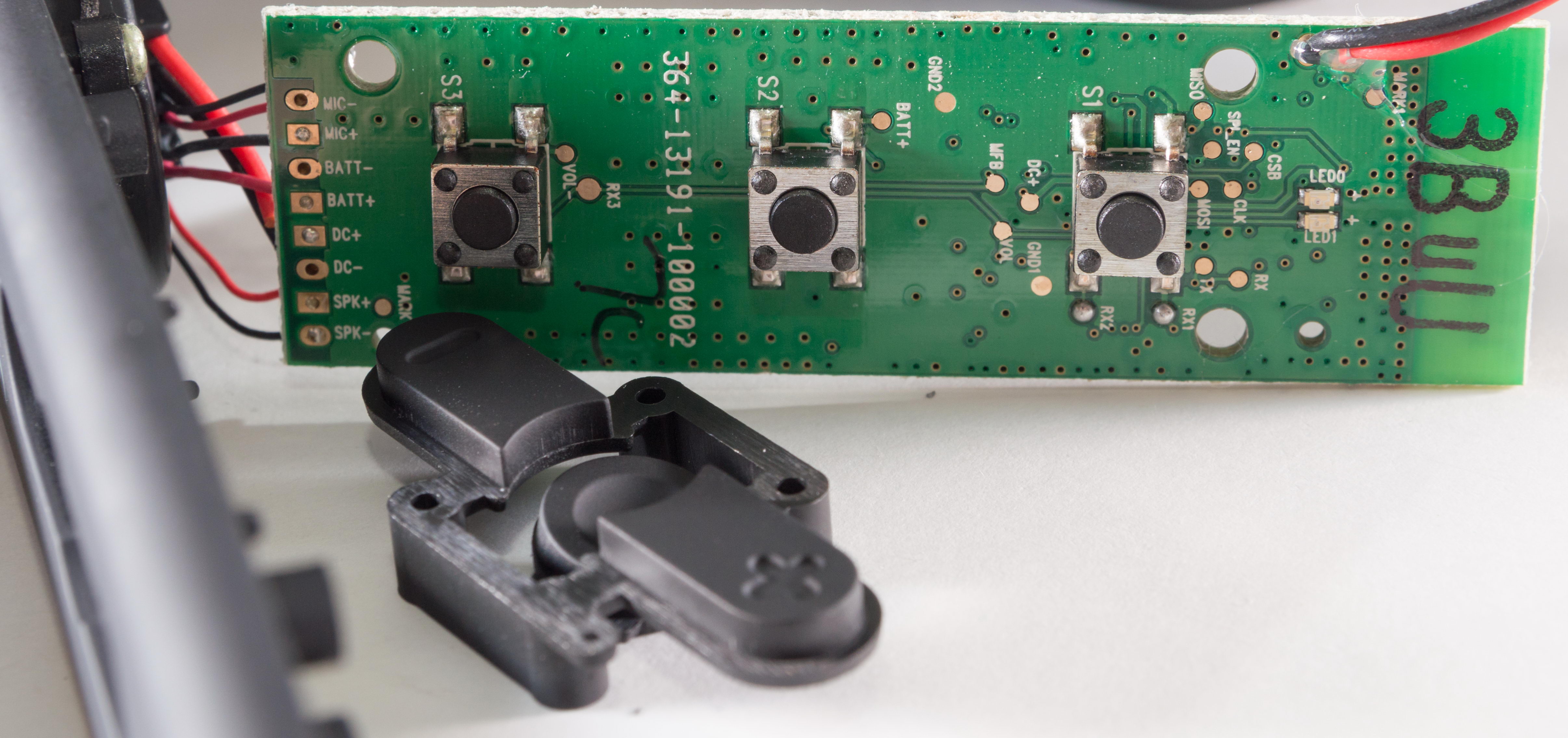
I’ve been having a lot of issues with noise from the bluetooth chip getting into the audio input, via the power.
Sometimes RC filtering of the supply has helped, but not always, and I just upgraded another amplifier and needed to install an encapsulated switching power supply inside the case just to run the bluetooth receiver.
One other thing I’m going to try is buying some of these 5V to 5V isolating power supplies
http://www.ebay.com.au/itm/Sip-4-B0505s … SwKOJYHmAM
They are cheap enough to buy a few to see if they are any good.
I’ll post to the postbag thread when I receive them
I am curious to see if I will have the same noise problem as Roger has.
I am curious to see if I will have the same noise problem as Roger has.
I am curious to see if I will have the same noise problem as Roger has.
My Subaru doesn’t have Bluetooth or an Aux input
I dont know if Subaru ever put an Aux in their vehicles.
I have to use one of those FM transmitters and listen to the phone via the radio, and the transmitter power on the one I have is so low, it gets interference from radio stations .
But, that gives me an idea, and perhaps I can find a more powerful FM transmitter module and attach it to one of those bluetooth dongles, and it will save me having to plug the audio jack into the phone
