
You can buy STAR OTTO LCD
http://time4ee.com/news.php?readmore=102
http://www.arduino.org/products/boards/ … -star-otto
http://www.st.com/content/st_com/en/pro … on_may2016
<…>
ST had the Arduino Headers on their Nucleo boards forever, but no IDE support, no software. Now they team up with the hardware branch of the after-split-arduino-team. The team that has not even gotten the Arduino Zero pinmap properly on their github. Then they also release the Arduino PRIMO board, a nRF52 + ESP8266 based platform, and there is also no sign of any IDE support …
<…>
ST had the Arduino Headers on their Nucleo boards forever, but no IDE support, no software. Now they team up with the hardware branch of the after-split-arduino-team. The team that has not even gotten the Arduino Zero pinmap properly on their github. Then they also release the Arduino PRIMO board, a nRF52 + ESP8266 based platform, and there is also no sign of any IDE support …
Has anyone downloaded the latest arduino.org IDE to see if it includes core files for this board ?
The .org folks have been building a web-based programming model. Would be easy to backend other web tools. It remains to be seen if they will differentiate between stand-alone and web.
Ray
I just looked at the ST site. I read it as this is going to use the .org Web based tool. Probably something like MBED.
I just looked at the ST site. I read it as this is going to use the .org Web based tool. Probably something like MBED.
I just looked at the ST site. I read it as this is going to use the .org Web based tool. Probably something like MBED.
Ever wonder why there were browser wars? It is a rhetorical question… puts yourhands down, no typing required – I will tell you.
“Metadata.”
–SNIP–
I could be wrong… but, I bet I am not 
I just love the small formats, and except for something like a 3d printer can’t really imagine what you’d need the huge boards for. The just seem so big, clumsy, and impractical to use, but maybe i’m totally missing the point.
I just love the small formats, and except for something like a 3d printer can’t really imagine what you’d need the huge boards for. The just seem so big, clumsy, and impractical to use, but maybe i’m totally missing the point.
Sounds like they have hitched their wagon to Arduino.org rather than Arduino.cc (Arduino.cc are at Maker Faire but I don’t think Arduino.org)
If I cant see them today, we have tickets for the weekend as well, so hopefully I will eventually to be able to get to the front of the queue 
I was looking forward to using http://www.seeedstudio.com/depot/Arch-M … -2632.html but they screwed up with the pinout.
They have built / or are developing a core based on the original libmaple F4 code, but they are only doing this as an interim step, before doing it properly using the STM Cube.
They had a few of these boards with them, but just for demo’s, I don’t think they are available to buy yet, and they didn’t know the exact final price – but I got the impression it was going to be over $50.
Unfortunately they didn’t have the new Nucleo 32 (Nano sized board), or the new wearables dev kit at the show either 
I wanted to speak to some other exhibiters as well, as I was only there around 20 mins, but I’ll see if they have time to chat tomorrow.
I also met the guys from Arduino.org, but they were busy on their own separate booth, so had to go back and mingle, so I didnt get time to ask about their STM stragegy – but again, I’ll try to speak to them more tomorrow.
I think it makes sense Arduino.org to team up with STM, as Arduino.cc already have agreements with various other manufacturers (but not STM as far as I’m aware)
But I think this board is probably to niche, and they should be focusing on something smaller and cheaper
I just looked at the ST site. I read it as this is going to use the .org Web based tool. Probably something like MBED.
Short version is the core for this should be on github in a week or two. The main concern with what little restrictions in the license is that they are concerned about the “official” ST code running on GD devices. This is new territory and much is still being explored.
The rep from .org was there and I had a nice chat with him as well.
Also visited .cc I think I spoke to one of the big names. He did not have a nametag and a lot of folk were attempting to get his attention. He referred me to one of the reps. There take was .cc accepts any pull requests for any hardware as long as it meets the API guidelines. Of course they really want “hardware licensees…”
I suspect Roger will have more to say as they had met with Rodger on Friday. As expected our paths did not cross.
Much busier at Maker Faire today (Saturday), with some different guys on the STM stand.
But I did manage to have a chat with Angelo from Arduino.org this afternoon, and like @sheepdoll said, they are hoping to release an initial version of a core for the STAR OTTO in the next few weeks.
They’ve only had the first boards for about a week and I think they have some hardware design / manufacturing issues which they are still sorting out.
This is not unusual, (as anyone who has done any hardware design will tell you)
Angelo has promised to send me a board in the next few weeks, so I will know more after the show when the dust settles.
I’m not sure how different the F469 is to the F407 and whether it will work straight away with the existing F4 code or whether our best bet is to use the HAL MX code.
As the Micro USB is on SDIO, it will probably be easier to add support for it and the other peripherals using the HAL MX core.
Slightly off topic…
I told both the STM guys and also Angelo that the F103 was really the device of choice for everyone at the moment, and I gave a Baite Maple mini to Angelo, to whet his appetite.
I doubt that Arduino.org would want to make a Maple mini board as there may not be much profit in it, as Baite already do a good job, but perhaps a F4 based maple mini. I recall that someone did make something like this, but I can’t remember who it was or what it was called.
IHMO, price is always a big issue, so if they did want to produce a small board they’d need to keep the price as low as possible (probably Teensy price bracket) for it to be successful.
The Arduino.cc stand was a lot busier and I didn’t think they would be interested in STM32, since thats what Arduino.org are doing, so I didn’t bother queuing up to speak to them.
Edit.
Not that this adds any information, but I did quick video of the board
https://www.youtube.com/watch?v=ImZA_SBUHHI
BTW.
From what I understood from Angelo, this is his project, as he wanted a ultra high performance board, and he has done some benchmarks showing the performance of this board vs the Uno and the Due etc, and its far far faster than most other Arduino boards
(Of course all there are other high performance boards available, but I suspect this will be the fastest currently available board that can be easily programmed using the Arduino IDE, as Angelo said they intend to make it as compatible as possible to the Uno and with the standard libs)

I wonder if Angelo has any comment whether the Otto is intended to be Open Hardware? According to the ST website it is licensed with their highly restrictive “Evaluation Products License”. Although ST publish schematics and even gerber files for their boards, their license says:
You are not authorized to use the Evaluation Board in any production system, and it may not be offered for sale
or lease, or sold, leased or otherwise distributed for commercial purposes. If the Evaluation Board is incorporated in an evaluation system,
the evaluation system may be used by You solely for Your evaluation and testing purposes. Such evaluation system may not be offered for
sale or lease or sold, leased or otherwise distributed for commercial purposes and must be accompanied by a conspicuous notice as follows:
“This device is not, and may not be, offered for sale or lease, or sold or leased or otherwise distributed for commercial purposes”.
which is quite ridiculous, even if it wasn’t for an Open Source board. I don’t think it is even legal, since hardware is not protected by copyright, so ST don’t have any rights to dictate what customers do with the hardware. Of course, they can still refuse to sell you products, so it would be very unwise to ignore the “license” and use the board in a commercial application.
@sheepdoll may be able to ask them in person, as she may be going today (Sunday), but 2 days at the Maker Faire was enough for me (and its over an hours drive from our hotel, so I cant just pop in
That license does seem crazy, and possibly not legal in many countries, but I wonder if what they are concerned about is liability of using consumer / hobbiest hardware in safety critical systems
Or I guess STM may be concerned about their other commercial partners
I will email Angelo and Federico about it, but I dont think the will respond for a few days as they are at the Faire 10 hours a day
Arduino boards are generally not used for “evaluation”, but either for education or for personal (or sometimes) commercial projects (especially bespoke projects)
We wont know about whether the pricing is comparable with the STM Nucleo or Discovery boards for a while, but I got the impression that this board will be more expensive than the existing Nucleo’s or Discoveries.

The only hope is that they’ll make their own arduino framework on top of halmx generated code, and that we could use that
defamations from customers that bought a device based on that evaluation board and may doesn’t work properly.
defamations from customers that bought a device based on that evaluation board and may doesn’t work properly.
I spent 4 hours yesterday. Doubt if I would learn anything new. I met most of the same people Rodger did and got the same story.
I did spend some time at the .cc both. .cc might be a better place to see if they could revive the Maple than .org
I found the existing F4 code to be quite a mess, which is why I did the HALMX lashup. The issue with most of this is that g_Pin2PortMapArray[] hack. I was over optimistic that I could edit this over the weekend to bring some of my variants in line with the latest. I am thinking I might approach ST for a Cube plugin that would generate a Ardino sketch variant or at least this table. The alternative would be to write a script that reads the .ioc and spits out a configured variant.
EVALUATION BOARD STATUS
The Evaluation Board offers limited features allowing You only to evaluate and test the ST products. The Evaluation Board is not intended for consumer or household use. You are not authorized to use the Evaluation Board in any production system, and it may not be offered for sale or lease, or sold, leased or otherwise distributed for commercial purposes. If the Evaluation Board is incorporated in an evaluation system, the evaluation system may be used by You solely for Your evaluation and testing purposes. Such evaluation system may not be offered for sale or lease or sold, leased or otherwise distributed for commercial purposes and must be accompanied by a conspicuous notice as follows: “This device is not, and may not be, offered for sale or lease, or sold or leased or otherwise distributed for commercial purposes”.
… or are you just cautioning Roger not to get a male & female board and start breading his own line of pedigree littl’ boards?
Ray
ok, its not like st has to pay 10$ for these MCUs, because well, they make them, but still. for something that will most definatly be produced in a small quantity (compared to the uno), i doubt it will be under 50$.
But with this board, STM commercials boys & girls can associate the well-konw name of arduino with stm32; “You can use arduino simple ide to program stm32” or “stm32 is as simple as an arduino to program, it is the same ide”. Nobody knows mbed, but arduino is also know outside makers world.
I am sure, it will be the same than nucleo board, lots of news/buzz when it was out, after nothing.
Arduino is build around atmega8/168/328, a rather limited member of AVR family…. and this is enough for 80% of people, if they want something bigger the answer is the Mega and that’s it. Look the maple board and the olimex clone (olimexino STM- I have it from 2011 but never used), they appeared about 6 to 7 years ago without much success. The truth is that Arduino STM interest revived because of the $2-$3 STM32 boards from china.
STM Arduino board for more than 50$ is just a marketing board.
<…> if they want something bigger the answer is the Mega and that’s it.
I like also the ATMega128 with the option of external RAM, I have finished many projects with it, in the past.
Putting char arrays in program memory (flash) due to small RAM. But then discovering that code has to change depending on if data is in RAM or program memory.
I’ve never seen Arduino w/GCC “hide” the issues like the above.
In some AVR-specific non-GCC compilers, I have.
I came to Arduino as a seasoned developer and found it odd to have to use PROGMEM and not just declare stuff as const, or just doing
char *myStr="Hello world";

Funny how if this will end up costing $50+ the price would be above/comparable to a full android phone/tablet that you can get on eBay with wireless / bluetooth / IPS touchscreen / GPS / cellular … etc.
Vassilis wrote:In my opinion, those Evaluation boards have not passed all the FCC tests (and not only) and do not meet all safety parameters. For that, those boards cannot be used in commercial products, to protect the ST from accusations /
defamations from customers that bought a device based on that evaluation board and may doesn’t work properly.
Hard to tell with the display. All they seemed to be doing was drawing white lines on it when I was there.
Large displays never seem to be cheap. There seems to be a huge price hike as soon as you get about the 2.4 or perhaps 3.2 in form factor. I’m not sure why this is, but I’d not be surprised if the display was $50 in its own right.
Re: Comparison with Android phones
Yes and no.
I know @mrburnette has looked at hacking a cheap Android tablet and I did the same thing, and there doesnt appear to be an easy way to do it, that gives you GPIO etc etc
Interfacing to Android devices never seems to be that easy. You may as well do it via BLE as by physical connection, usb drivers on different flavors of Andorid seem to vary.
. And also easy to program since i’m a .net programmer .. And also easy to program since i’m a .net programmer . Funny how if this will end up costing $50+ the price would be above/comparable to a full android phone/tablet that you can get on eBay with wireless / bluetooth / IPS touchscreen / GPS / cellular … etc.
Vassilis wrote:In my opinion, those Evaluation boards have not passed all the FCC tests (and not only) and do not meet all safety parameters. For that, those boards cannot be used in commercial products, to protect the ST from accusations /
defamations from customers that bought a device based on that evaluation board and may doesn’t work properly.
Re: Comparison with Android phones
Yes and no.
I know @mrburnette has looked at hacking a cheap Android tablet and I did the same thing, and there doesnt appear to be an easy way to do it, that gives you GPIO etc etc
Interfacing to Android devices never seems to be that easy. You may as well do it via BLE as by physical connection, usb drivers on different flavors of Andorid seem to vary.
I’m working at ST, therefore I can clarify a bit. Here are some elements of answer versus some of topics raised in that thread:
- This board is full ownership of Arduino and was fully designed by Arduino. We can’t comment on the final price (that we don’t know even)
- The web page on ST site is just a marketing exposure for this board, with redirection onto Arduino web site. FYI there is a mistake on this page, showing a specific license from ST. This doesn’t apply at all to this object, that is anyway not ST ownership at all. We’ll correct that to avoid such misunderstanding.
- The used MCU is the STM32F469, featuring a Cortex-M4 going up to 180MHz, 2Mb Flash and 384Kb of SRAM. It also features the ChromART 2D Graphic accelerator and a DSI interface. Arduino will sell an additional shield with a nice screen, to take benefit from such graphic features. I don’t know about softare coverage however
Hope this helps
SeaFood
I’m working at ST, therefore I can clarify a bit. Here are some elements of answer versus some of topics raised in that thread:
- This board is full ownership of Arduino and was fully designed by Arduino. We can’t comment on the final price (that we don’t know even)
- The web page on ST site is just a marketing exposure for this board, with redirection onto Arduino web site. FYI there is a mistake on this page, showing a specific license from ST. This doesn’t apply at all to this object, that is anyway not ST ownership at all. We’ll correct that to avoid such misunderstanding.
- The used MCU is the STM32F469, featuring a Cortex-M4 going up to 180MHz, 2Mb Flash and 384Kb of SRAM. It also features the ChromART 2D Graphic accelerator and a DSI interface. Arduino will sell an additional shield with a nice screen, to take benefit from such graphic features. I don’t know about softare coverage however
Hope this helps
SeaFood
https://youtu.be/OTjQdQGnhzA?t=244
Pricing .. about $80
Lets remember that STMDiscovery-F746 is priced at $49 …
Lets remember that STMDiscovery-F746 is priced at $49 …
Lets remember that STMDiscovery-F746 is priced at $49 …
I was to lazy to compare both datasheets side-by-side …

~Straw
http://hackaday.com/2016/05/27/federico … no-boards/
it seems that the PRIMO has also an STM32F103.
” But on the Primo you get two more controllers: an ESP8266 and an STM32F103.”
It is a bit difficult for arduino world to handle such complex and probably expensive system.
Connectivity is a good thing but here we have 3 different technologies in separate silicon. ESP for Wifi, Nordic for Bluetooth and STM for USB.
I am waiting more info about it.
I presume they pre-flash the ESP8266 and nRF52 with firmware and there is an Arduino API to communicate to those devices
Arduino.org seem to be going for the high end of the market, as the cost of a 3 processor board will be far far higher than a Uno
Personally, I would have just produce a board based on a nRF52 as the main processor, as its programmable via GCC (and Nordic produce a SoftDevice (runtime static lib) and gcc compatibe wrapper), and there is already an Arduino core for this (produced by Sandeep Mistry)
Or produce a ESP8266 only board
Or a F103RE only board
After avr based UNO, and ZERO, a more powerfull arm based board as a third option is a good idea. Maybe something based on F401/F411.
But! it must be simple, clean and low priced. I think what it is possible to produce such a board at around 25$. Any extra interface like Bluetooth or Wifi can be available as a shield or by other add-on way.
All these complex and expensive boards available under arduino brand, each one with different architecture, scatter development efforts and confuse people. I see only marketing “games” from semiconductor companies and arduino people as they are trying to capitalize on arduino success.
Personally, for high specs/priced boards, I like linux boards like rasberryPi or BananaPi or my favorite Olinuxino-LIME (from olimex).
I think you are right…. These boards seem to have been designed by the marketing department.
A board with just the nRF52 looks like it would be as powerful as an STM32F103, as it uses the ARM Cortex-M4 processor @64Mhz and has 512k flash and 64k RAM (the RAM and flash size may vary depending on which version is used)
Perhaps the F103RB is purely being used as the USB interface device, but in which case it seems over spec’ed as you would only need a F103C8 not an F103R8 (though I suppose they are virtually identical apart from package)
Perhaps they will bring out an ESP32 board and do away with both the nRF52 and the ESP8266, and just use a CH240 etc for programming
(or perhaps use a F103 as the USB programmer)
https://www.seeedstudio.com/item_detail.html?p_id=2632
$19.95 for an F407 with Ethernet, it is pretty appealing !
https://www.seeedstudio.com/item_detail.html?p_id=2632
$19.95 for an F407 with Ethernet, it is pretty appealing !
https://www.seeedstudio.com/item_detail.html?p_id=2632
$19.95 for an F407 with Ethernet, it is pretty appealing !
I’ve placed my order before stock is running out !

I think you are right…. These boards seem to have been designed by the marketing department.
A board with just the nRF52 looks like it would be as powerful as an STM32F103, as it uses the ARM Cortex-M4 processor @64Mhz and has 512k flash and 64k RAM (the RAM and flash size may vary depending on which version is used)
Perhaps the F103RB is purely being used as the USB interface device, but in which case it seems over spec’ed as you would only need a F103C8 not an F103R8 (though I suppose they are virtually identical apart from package)
Perhaps they will bring out an ESP32 board and do away with both the nRF52 and the ESP8266, and just use a CH240 etc for programming
(or perhaps use a F103 as the USB programmer)
Mostly Leaflabs, ST HAL barely used …
This is inline with what they sold various people at Maker Faire.
I have not heard from either the Arduino guys or the ST guys for a while.
But, the impression I have, is that they have not started work on a core that uses the CMSIS or HAL etc as yet.
The hal/cmsis sources are included, but I don’t know if they are used and for what.
It seems to me like a work in progress, replacing functions of libmaple with hal. It is interesting……
The hal/cmsis sources are included, but I don’t know if they are used and for what.
It seems to me like a work in progress, replacing some functions of libmaple with hal. It is interesting……
http://rogerclark.net/uploads/star_otto_core.zip
just unzip into your arduino hardware folder
Seems to compile OK.
waitfor 0 /t 1 2> NUL

%1\dfu-util.exe -l -d %2 -a %3 -s %4 -D %5

%1\dfu-util.exe -l -d %2 -a %3 --reset-stm32
I have a F4 Discovery board, but I am not sure its worth spending any time to see if this core works on that board, as it really looks like an interim silution until they rewrite again from scratch using the HAL
I just received an email from Francesco, letting me know that their code was based on my repo.
But there were no other technical details.
@grumpyoldpizza
I have replied, letting him know about your core, as I suspect it would be possible to modify it to work for the F4, and reminding him about @sheepdoll’s HAL MX based core.
i have no more information about this board, as this is the first email I have had from Arduino.org since Maker Faire ( which was almost a month ago).
@grumpyoldpizza
I have replied, letting him know about your core, as I suspect it would be possible to modify it to work for the F4, and reminding him about @sheepdoll’s HAL MX based core.
F4 and L4 are not that different. Only DMA and I2C come to mind as biggies..
The subhead “Giant seen as ‘adrift’ and ‘a survivor'” is also an interesting way of looking at things.
Like the AVR forums, there was some negativity regarding Cube. Equating it to a two year train wreck. The same commenter was also not too kind when they wrote “The Maple board design was disappointing…”
I am not direct linking this as I am not sure how long EETimes morgues the articles. This used to be a print magazine that went totally digital. So the articles are a bit topical and ephemeral. So dear reader, you will have to use your favorite search engine to pull up the above titles.
I found it by googling “STMicroelectronics Seeks Revival”, albeit, I seemed to go straight to the comments page, and had to click to get back to the initial article.
I don’t have much experience of using the Cube, but at the moment the jury is out for me, because I’ve had a number of problems with it, including
* Projects that were updated, seem to have files missing and would no longer compile.
* Corresponding files for different MCU series, seem to have different level’s of bug fixes and enhancements applied to them (case in point was the F3 was missing a guard #ifdef around the Vector offset, but the same file for the F0 had the guard code.
* Plus a few more minor problems that I can’t recall at the moment.
I get the feeling that they don’t spend a lot of time supporting the cube, and consequently each MCU series series doesn’t get the same bug fixes and enhancements.
I suppose ST’s goal was not to write a tool that would generate code so that users could upgrade from one processor series to another (which is what we need to build a unified “core”)
Also, I tend to agree with @clive1’s posting in to the story. I don’t know if the upper levels of STM understand Open Source.
Case in point is the code license on their CMSIS etc, prior to the Cube.
I cant see how it benefited them, to have a non-redistribution clause on their code, apart from stopping people using it in any publicly available project (hence any Open Source project), and hence limiting their visibility in the market place
Its not was if you had to sign a NDA etc to get the Standard Peripheral Library, it was freely downloadable.
Speaking to the reps at Maker Faire, they told me that ST was not just interested in mass / commercial market, but I find it hard to reconcile their actions.
I found it by googling “STMicroelectronics Seeks Revival”, albeit, I seemed to go straight to the comments page, and had to click to get back to the initial article.
I don’t have much experience of using the Cube, but at the moment the jury is out for me, because I’ve had a number of problems with it, including
* Projects that were updated, seem to have files missing and would no longer compile.
* Corresponding files for different MCU series, seem to have different level’s of bug fixes and enhancements applied to them (case in point was the F3 was missing a guard #ifdef around the Vector offset, but the same file for the F0 had the guard code.
* Plus a few more minor problems that I can’t recall at the moment.
I get the feeling that they don’t spend a lot of time supporting the cube, and consequently each MCU series series doesn’t get the same bug fixes and enhancements.
I suppose ST’s goal was not to write a tool that would generate code so that users could upgrade from one processor series to another (which is what we need to build a unified “core”)
I have seen so much bloatware in MBED, CMSIS, CubeMx, and even in SPL that it has been disgusting. The libraries that Paul has created for Teensy are an example of more professional design.
Cheers, Ollie
* Specifically, support for MCU specific peripherals across the wide variety of STM32Fx series MCUs
* Free bug fixes of the HAL etc, when STM releases updates.
* Ability to use STM example code and libraries ( ones that use the HAL )
* Ability to reuse other open source code that uses the SPL, albeit this requires porting to the HAL.
@ollie.
IMHO, Unfortunately, the user base is simply not big enough to support the development of a cleanroom API.
Also, in some respects libmaple can be viewed as a cleanroom API, but a common complaint is that either it doesn’t support a particular processor variant, or specific built in hardware, or allow use of STM examples , that use the SPL or HAL.
People are time poor, which limits their ability to contribute, and consequently the changes to the libmaple core are normally limited to bug fixes, rather than support for built in peripherals like CAN and SDIO, or modifying libmaple to work with other processor variants e.g. F0
I’m not sure why the core seemed to compile when I removed the HAL, but when I looked again, its definitely needed.
What Francesco has done, is to use use both libmaple and the HAL at the same time.
The HAL seems to be use for features which are not supported by the F4 version of LibMaple.
Specifically Hardware SPI and also Hardware I2c (Wire)
SPI and Wire are not done as separate libraries, but have been put inside the core. (I’m not sure why this is)
Of course the drawback of using both libmaple and the HAL is it appears to double the code size (for a blank sketch), and increase the amount of RAM used
e.g.
STAR OTTO
Sketch uses 27,180 bytes (1%) of program storage space. Maximum is 2,097,152 bytes.

Global variables use 14,680 bytes of dynamic memory.
I have asked engineers at STM in one of their recent webinars about Arduino library support and I am under the impression that they are not behind the scene doing the work for that board.
With nucleo, they just have the board and claim the pin compatibility, and there is definitely no desire to provide library for it.
As for licensing issues with Cube code, HAL drivers are under BSD license and the source is redistributable.
But any vendor peripheral libraries sucks – because they do not take application into consideration and they do not push the codes to limit and fixing the bugs.
So, personally, I believe it should always be good to come up with your own peripheral libraries for your specific application ^.^
Welcome…
From what I understand, Arduino.org are doing all the S/W dev, by taking the libmaple core and using the HAL to add peripheral support for the MCU they are using. In my email conversions with STM, they (STM) didn’t seem to be devoting any resources to doing Arduino “core” development.
I know other people have asked about Arduino support why at STM32F7 seminars, and have been met with blank faces.
The STM guys at the Bay Area Maker Faire, were much more in turn to this market, but I think they are the exception to the rule.
But any vendor peripheral libraries sucks – because they do not take application into consideration and they do not push the codes to limit and fixing the bugs.
First of all I wish introduce me.
I’m Francesco Alessi, and I’m the main developer of Arduino STAR OTTO. I have to say thanks to Roger for his work on maple, I started the development from his repo. I have also to say thanks to some ST guys, that supported (and still supporting) me during the development.
To reply to someone, not all of ST people know about OTTO, because this board is not a ST board (was developed with the support of ST), but is a pure Arduino.org board, designed, produced and developed in Italy .
The code of OTTO is on the Arduino.org repository, in STM32F4 branch: https://github.com/arduino-org/Arduino/tree/stm32f4
I’m writing for two reason:
1) I wish to develop the code of OTTO with yours suggestion, because my idea is to have realy one board developed together, looking in the direction that you suggest, hoping to develop the code in the best way, and if you want with yours contributions.
2) If for you is a good idea, I will ask to my colleagues to open a specific section of Arduino Forum, to have an official place to gather all comments and suggestion (of course without leaving this beautiful place to discuss, which is a reference for all community of developers STM32). I wish to open the forum section because I’m able (I hope) to reply to your technical question, but not for other questions, and the forum is readed also from other guys that may know other answers.
I’m ready to reply to all of your questions!
Ciao to all!
Francesco.
Is Arduino.org intending to make other STM32 boards?
I wonder if the best way to structure the forum is to Merge the Maple and Maple mini sections onto “Maple boards (and clones)” and add “Arduino.org boards” as a new section
Is the OTTO pricing and specs have been finalized ?
Ciao !
benvenuto in questo forum!
I’m ready to reply to all of your questions!
– when it will be available
– what will be the price
– what are the libraries
In this board, I like the F469. The ESP8266 is ok, but ESP8285 would have been better. If the design would start now, the ESP32 could be a viable alternative.
Cheers, Ollie
Sorry for silence, but I was really busy on Hardware revision of OTTO.
About some question you posted:
Price: I have no precise information
Availability: as soon as possible, I’m working Hard!
libraries: some code is on Arduino.org GitHub repository, is not a definitive code, but if you want you can give a look inside the code. Notes, suggestions and contributions are welcome!
The choice about ESP8266, is related to the fact we use the same chip in several boards like UNO WiFi and Primo.
for further information, please refer to Arduino.org web site.
Ciao.
Francesco.
Did you manage to finish the SDIO library. I know some people were interested in your progress with this.
Thanks
Roger
I got Arduino STAR OTTO revision 2.
Photogallery is here http://time4ee.com/news.php?readmore=179
I got Arduino STAR OTTO revision 2.
Photogallery is here http://time4ee.com/news.php?readmore=179
Unboxing of Arduino STAR – OTTO and how to upload the code
https://www.youtube.com/watch?v=68HeH4-xTMI
It would need to come with pillars, otherwise it will not rest flat on a bench.
Shame the video didnt have any commentry.
I also presume they are still using a modified version of libmaple as their core, because AFIK STM have not finished their official F4 core yet.
& on the pcb just wires, pin headers, resistors & capacitors, ethernet jack, power connector
https://time4ee.com/news.php?readmore=102
this is nearly the same for beagle bone black wireless as well
https://beagleboard.org/black-wireless
https://github.com/arduino-org/arduino-core-stm32f4
And Yes: It’s based on libmaple
The issue does not specify how “easy” is to adapt this to other chips/boards, so that I will give it a try.
No ESP8266, DSI, SDRAM or audio.
Works like a STAR Otto board in Arduino IDE.
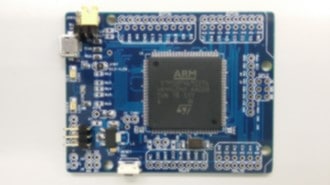
- pcb.jpg (22.61 KiB) Viewed 811 times
could you please give more details about your work (schematic, software source, etc.)?
I think it would be useful if you would open a new thread under “STM32F4 Boards”.
Updated to be more precise..
[Pito – Thu Jul 13, 2017 11:30 am] –
F469 in arduino headers format – what would be the targeted audience with it?
Maybe everyone that got excited with the Otto but could never get it?
[Pito – Thu Jul 13, 2017 11:30 am] –
144pins F469 in arduino UNO headers format – what would be the targeted audience with it?
Updated to be more precise..
Perhaps a Due factor would have been better to use the pins?, or rather use an F469 with a smaller count of pins, but pretty much any version would have more pins than an UNO.
Still for people that need the cpu power and internal peripherals but not the pins may be a good option.

