FurkanCetin
Sun Sep 20, 2015 12:16 pm
Hi friends
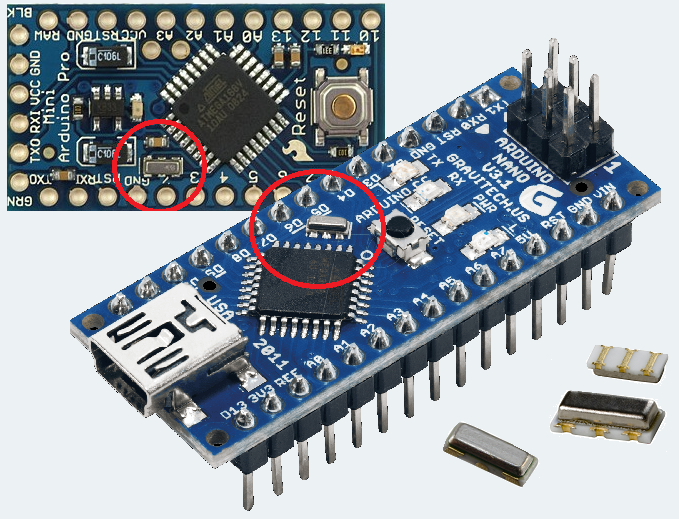
In near future, I’ll start designing my PCB for STM32 Smart Watch project. I am curious about using MURATA crystals with built in capacitors. They are so commonly used in Arduino boards for its small size. Can anyone confirm that I can use them with STM32F103CB, for both 8mhz one and 32.768 one RTC requires? Here are some links:
SeeedStudio Open Component Library – 8mhz
Digikey – Murata 8mhz Crystal
I examined OpenCM board’s datasheet (which uses STM32F103CB) and saw that 8mhz oscillator is paired with 22pF capacitors. In Arduino boards, Atmega328 is also combined with 22pF capacitors with 16mhz crystal (and same with 8mhz when it’s 3.3V). If it works, it would be great for me to use 1 component with 3 pads instead of 3 components with 6 or 8 pads (depending on the smd crystal).
madias
Sun Sep 20, 2015 1:52 pm
It’s all about the accuracy: Quartz = high acc. , resonator = lower acc.
This question was discussed often, like:
http://www.instructables.com/answers/Ce … r-arduino/
So for the RTC I personally wont take a resonator, for the HSE: good question, depends on the additional peripheries.
ahull
Sun Sep 20, 2015 4:47 pm
There is a little bit of background on RTC and crystal selection here…
http://www.stm32duino.com/viewtopic.php?f=15&t=132 I must confess I simply slapped on a low cost watch crystal with no caps.
Something like this and it woks fine. There are registers on the STM32F103 to allow you to tune the RTCclock to match the crystal, for greater accuracy but I didn’t explore that.
stevech
Sun Sep 20, 2015 10:07 pm
I’ve read that even good crystals for RTC purposes are not as accurate as you’d like… much less than a quartz crystal based wristwatch.
Such watches are very accurate for two reasons
1) the manufacturer laser-trims to get the oscillator freq. very close
2) such watches don’t have temperature extremes because of proximity to body and elsewhere, a nice in-home ambient.
(1) is the key, else you’ll likely see seconds of drift in a few days.
Some people put tweaks in the microprocessor to fudge the RTC absolute time now and then, based on measurements to determine the needed correction. This is in lieu of (1). The ST32’s have an RTC calibration fudge register to do this.
mrburnette
Sun Sep 20, 2015 10:15 pm
FurkanCetin wrote:Hi friends
<…>
If it works, it would be great for me to use 1 component with 3 pads instead of 3 components with 6 or 8 pads (depending on the smd crystal).
zoomx
Mon Sep 21, 2015 12:43 pm

never heard about gimmick capacitor! Thanks Ray!
FurkanCetin
Mon Sep 21, 2015 3:12 pm
Thanks for info and tips.
For some versions of the smart watch, I will avoid the deep details and focus on the overall design. But I got the idea of using a Quartz instead of a Resonator. It will be sufficiently accurate for timing. In each connection, I could set the time from smartphone to avoid drifting.
For each of 8 mHz and 32.768 mHz oscillation, a quartz with two capacitor will take some place on PCB and it’s considerable when you try to stuck everything on a 30cm x 18cm board. Anyway, I will choose the reliable way.
ahull
Mon Sep 21, 2015 5:07 pm
FurkanCetin wrote:Thanks for info and tips.
For some versions of the smart watch, I will avoid the deep details and focus on the overall design. But I got the idea of using a Quartz instead of a Resonator. It will be sufficiently accurate for timing. In each connection, I could set the time from smartphone to avoid drifting.
For each of 8 mHz and 32.768 mHz oscillation, a quartz with two capacitor will take some place on PCB and it’s considerable when you try to stuck everything on a 30cm x 18cm board. Anyway, I will choose the reliable way.
stevech
Tue Sep 22, 2015 2:35 am
Doesn’t your time, using 32768 crystals without calibration drift seconds in a few days?
zoomx
Tue Sep 22, 2015 7:30 am
The MSP430 Launchpad board has only the 32768 crystal, the one that is inside the box that you can solder. On the board there are pads for the capacitors but there are not capacitors.
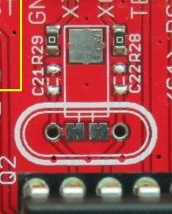
As you can see there are two resistors. The provided crystal is cilyndrical.
ahull
Tue Sep 22, 2015 10:02 am
stevech wrote:Doesn’t your time, using 32768 crystals without calibration drift seconds in a few days?
mrburnette
Tue Sep 22, 2015 9:43 pm
stevech wrote:Doesn’t your time, using 32768 crystals without calibration drift seconds in a few days?
primateio
Fri Nov 13, 2015 3:02 pm
Since you are going to have Bluetooth, it is feasible to make it where you update the clock periodically from your phone automatically. You could just use the internal oscillator or the external ceramic one you mentioned, and run your clock off that without a RTC crystal. Even if it drifted a whole minute every day, you could set the time daily so the drift would not affect you long term. It would take some coding on the phone side of things, but if it is a smartwatch that connects to the phone anyway, you are already there. You may run into occasional timing issues if your bluetooth module uses uart instead of SPI, but it should be fine at lower baud rates.
mrburnette
Fri Nov 13, 2015 4:00 pm
primateio wrote:Since you are going to have Bluetooth, it is feasible to make it where you update the clock periodically from your phone automatically. You could just use the internal oscillator or the external ceramic one you mentioned, and run your clock off that without a RTC crystal. Even if it drifted a whole minute every day, you could set the time daily so the drift would not affect you long term. It would take some coding on the phone side of things, but if it is a smartwatch that connects to the phone anyway, you are already there. You may run into occasional timing issues if your bluetooth module uses uart instead of SPI, but it should be fine at lower baud rates.
ahull
Fri Nov 13, 2015 4:11 pm
mrburnette wrote:primateio wrote:Since you are going to have Bluetooth, it is feasible to make it where you update the clock periodically from your phone automatically. You could just use the internal oscillator or the external ceramic one you mentioned, and run your clock off that without a RTC crystal. Even if it drifted a whole minute every day, you could set the time daily so the drift would not affect you long term. It would take some coding on the phone side of things, but if it is a smartwatch that connects to the phone anyway, you are already there. You may run into occasional timing issues if your bluetooth module uses uart instead of SPI, but it should be fine at lower baud rates.
mrburnette
Fri Nov 13, 2015 4:21 pm
@Andy:
I think people in a commercial establishment expect “nearly exact” time because they are likely planning on leaving the hotel for a meeting/lunch/dinner/airplane/train/etc. Or, they are traveling and need to adjust their timepiece (Timex?). When people pay for something, everything that is considered an amenity comes under strict(er) scrutiny.
Now, I am a time-freak… I want my watch synced to the second – everyday. The solar timepieces are on a chest-of-drawers facing a bright window along with a Seiko solar WWVB clock (one of the few that actually syncs 365x a year here in Georgia. I also have a Junghans MEGA that is 20 years old than never misses a sync cycle.) Most $20 Chinese “atomic” clocks only syncs occasionally to WWVB due to modern electrical noise in homes.
Ray


